


Most people are concerned about the need for security and growth in their careers, including the dignity of knowing that they are able to contribute in their roles, said President Tharman Shanmugaratnam.
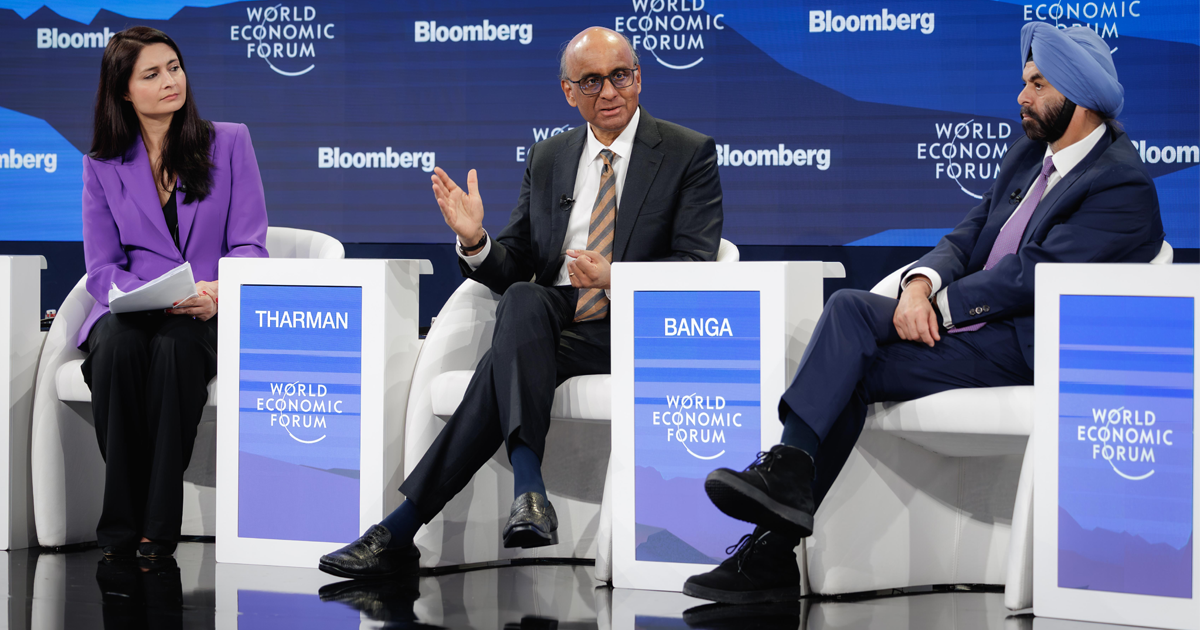
President Tharman, who also co-chairs the World Bank Group's high-level advisory council on jobs, was speaking at the World Economic Forum's session on the jobs challenge in emerging markets on Wednesday (Jan 21) in Davos.
Speaking after Ajay Banga, president of the World Bank Group, who talked about concerns regarding the insufficiency of jobs in emerging markets for people coming of age, President Tharman agreed that geopolitics aside, most people would be most concerned about jobs.
He said: "Ask ordinary people around the world what their main concerns in life are, what is on the minds of most people is the need for security and growth in their careers.
"Not necessarily the same job, but the security of a career, growth through their lives, and the dignity of knowing that they are able to contribute."
He said that as societies get older, workers would also be concerned about their retirement years, which in turn depend on their years at work.
"So, if we start with what's on the minds of most people, jobs must therefore be a central priority," added President Tharman.
Rethinking jobs creation - from an upstream and downstream approach
An economist by training, he suggested looking at the issue from both an upstream and a downstream approach.
He pointed to how studies have shown that "early-stage investments' — starting from in-utero nutrition during a mother's pregnancy — have helped the young gain the "largest multipliers over a lifetime".
Turning to the education system, he noted that education systems around the world are still "overly academic".
President Tharman said: "It should not be an either-or choice of an academic or more technical education. It has to be about providing pathways for everyone to ascend and excel through the pathway that matches their interests and capabilities.
"We have to reduce the hierarchy that still exists — all over the world and especially in Asia — between those on the academic path and those on the technical vocation path."
He suggested that the way to address this issue is to provide real opportunities to excel and attain mastery within the technical and vocational and applied paths.
Moving downstream, President Tharman noted that there are "real opportunities" in jobs creation today — unskilled, semi-skilled and high-skilled — which did not exist when East Asia economies took off between the 1970s and 1997.
He pointed out that while today's manufacturing sector is increasingly about advanced robotics and artificial intelligence, middle-income countries such as Brazil, Malaysia and Vietnam are not yet in top-end, high-skill manufacturing.
Meanwhile, China has moved up to "very high skills levels", but is still doing a lot of traditional low-end manufacturing using advanced equipment, President Tharman said.
He suggested that if part of that can be transferred to Africa and South Asia, it would not only create a big lift in manufacturing employment, but also address the domestic imbalances in China owing partly to the overproduction of manufacturing goods.
Green transition in job creation
Finally, he turned to the potential of green transition in job creation in the developing world, highlighting that Africa and South Asia are rich in hydro, solar, thermal and wind, presenting natural opportunities to be sites for energy-intensive production for the world, apart from their own regional markets.
"The studies show that the number of jobs created by a dollar of investment in renewable energy is some three times higher than in fossil fuels," he noted.
The World Bank had highlighted a potential shortfall of about 800 million jobs for the 1.2 billion young people coming of age in emerging markets over the next 12 to 15 years, said Banga in his speech.
[[nid:728435]]
editor@asiaone.com