
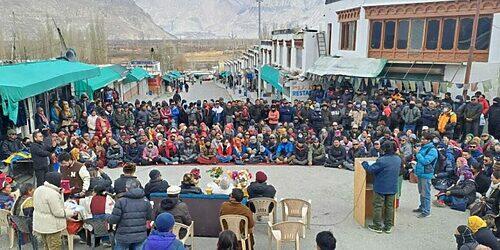

The Union Territory of Ladakh has witnessed a critical policy development concerning government employment rights for its indigenous population. Since the abrogation of Article 370 and 35A on August 5, 2019, which redefined Ladakh’s administrative and constitutional framework, significant changes impacted local employment policies. Faced with persistent demands from native groups, the Ladakh administration is now moving towards reinstating the pre-August 5, 2019 position that reserves government jobs exclusively for locals. This article explores the background, policy changes, ongoing agitation, and implications of this restoration, providing a comprehensive understanding of the evolving employment landscape in Ladakh.
Background: Pre-August 5, 2019 Employment Policies in Ladakh
Prior to August 5, 2019, Ladakh’s government job policies were deeply intertwined with its special constitutional status under Article 370 and Article 35A of the Indian Constitution. These provisions allowed Ladakh to maintain exclusive rights for locals in government employment, particularly reserving many posts for permanent residents. The Permanent Resident Certificate (PRC) system, rooted in the Dogra-era notifications of 1927 and 1931, was the primary criterion to define eligibility for government jobs.
This system effectively barred non-residents from competing for many public service roles, ensuring that the region’s indigenous communities retained control over administrative positions. The reservation was not limited to non-gazetted posts but also extended to higher-level gazetted posts, ensuring comprehensive local representation across government departments.
The protection of locals’ employment rights was a crucial aspect of Ladakh’s socio-political identity, fostering a sense of security and cultural preservation among its diverse ethnic groups, including Buddhists in Leh and Muslims in Kargil.
Impact of the August 5, 2019 Abrogation of Article 370 on Employment
The revocation of Article 370 and the bifurcation of Jammu and Kashmir into two Union Territories—Jammu & Kashmir and Ladakh—on August 5, 2019, marked a significant turning point. The special status that safeguarded exclusive local rights in Ladakh was nullified, introducing new administrative norms and recruitment policies. This shift raised concerns among Ladakhi natives about the dilution of their traditional employment protections.
Following these changes, the government opened many job categories to non-locals, disrupting the long-standing reservation system. This led to fears about the erosion of local cultural identity and economic opportunities for Ladakh’s indigenous population, intensifying demands for the restoration of prior safeguards.
The initial months after the abrogation saw mixed reactions: while some sectors welcomed new opportunities, the indigenous communities, especially in Leh and Kargil, united in protests advocating for the reinstatement of the pre-2019 employment policies.
Government Initiatives to Restore Local Employment Rights
Responding to the sustained agitation, the Union Ministry of Home Affairs (MHA) issued a notification on November 1, 2022, empowering Lieutenant Governor Radha Krishna Mathur to frame recruitment rules for gazetted (Group A and B) government jobs in Ladakh. This marked a significant administrative step toward restoring local employment rights at higher government service levels.
The MHA notification also delegated authority to the L-G to define qualifications, probation, confirmation, seniority, and promotion conditions for these posts. These powers enable the administration to design a framework reflecting the pre-2019 employment scenario, emphasizing reservation for natives possessing the Ladakh Resident Certificate.
Subsequently, from November 14, 2022, draft recruitment rules for various departments were released publicly. These drafts explicitly restrict gazetted posts to candidates holding valid Resident Certificates, issued under the Union Territory of Ladakh Resident Certificate Order (Procedure), 2021, thereby barring non-locals from these positions.
The Role of Resident Certificates in Defining Local Eligibility
The Resident Certificate has become the cornerstone of eligibility for government jobs in Ladakh. Introduced through the 2021 Resident Certificate Order, it builds on the legacy of the Permanent Resident Certificate system that dates back to early 20th-century Dogra rulings. This certificate certifies an individual’s permanent residency status, serving as proof of their indigenous rights within the UT.
To be eligible for government employment under the new rules, candidates must hold this certificate, which is issued by competent authorities following strict procedural guidelines. This ensures that only bona fide residents of Ladakh can apply for reserved government jobs, reinforcing local employment protections.
The Resident Certificate system not only safeguards job rights but also plays a broader role in preserving Ladakh’s cultural and demographic integrity. It acts as a regulatory tool to balance developmental priorities with the protection of indigenous interests.
Local Agitation and Political Responses to Employment Policies
The restoration of employment rights has been a central demand of local organizations such as the Leh Apex Body (LAB) and the Kargil Democratic Alliance. These groups have been actively protesting since the 2019 abrogation, demanding statehood, constitutional safeguards akin to the Sixth Schedule, and enhanced parliamentary representation alongside job protections.
Thousands of residents from both Leh and Kargil districts have participated in protests, setting aside historical ethnic and political differences to unite for common goals. The protests on November 2, 2022, exemplified this solidarity, with calls for continued agitation if demands remain unmet.
Former ministers and community leaders have welcomed the government’s recent moves to reserve gazetted jobs for locals but emphasize that these steps alone are insufficient. They maintain pressure on the Union government to address broader political and constitutional demands to ensure comprehensive autonomy and rights for Ladakh.
Inter-District Cooperation Between Leh and Kargil
Historically, Leh and Kargil districts have had divergent political allegiances and cultural identities, with Leh predominantly Buddhist and Kargil mostly Muslim. These differences influenced their respective stances on Jammu and Kashmir’s special status and the UT reorganization.
Post-August 2019, however, both districts have found common ground in their pursuit of safeguarding indigenous rights, particularly concerning employment and land ownership. This newfound unity has strengthened their collective bargaining power with the Union government.
The cooperation between Leh and Kargil represents a significant shift in Ladakh’s socio-political dynamics, potentially setting a precedent for collaborative governance and regional development policies that prioritize local interests.
Implications for Jammu and Kashmir and Broader Regional Politics
The Ladakh administration’s move to restore pre-2019 employment policies is likely to reignite debates in Jammu and Kashmir regarding similar protections for locals. Currently, the J&K Civil Services Act allows non-locals who have resided in the UT for 15 years to apply for government jobs, a policy markedly different from Ladakh’s stringent residency requirements.
This divergence may prompt political actors in J&K to demand comparable safeguards, potentially influencing future recruitment and administrative policies across the Union Territories. The developments in Ladakh may thus have a ripple effect on regional politics and governance frameworks.
Moreover, the restoration of local job rights in Ladakh could become a benchmark for other regions seeking to balance demographic changes with indigenous rights, highlighting the complex interplay between constitutional law, local identity, and administrative governance.
Future Outlook and Challenges Ahead
While the restoration of local employment rights marks a positive development for Ladakh’s indigenous communities, several challenges remain. The administration must ensure transparent, efficient implementation of the new recruitment rules to prevent ambiguity and disputes over eligibility.
Additionally, the broader political demands—such as statehood, constitutional safeguards, and enhanced parliamentary representation—are yet to be addressed, indicating that the agitation and negotiations are far from over. The government’s engagement with local stakeholders will be critical in maintaining peace and fostering inclusive development.
Finally, balancing economic growth, infrastructure development, and demographic changes while preserving Ladakh’s unique cultural fabric will require nuanced policies beyond employment rights. The coming years will be pivotal in shaping Ladakh’s socio-political trajectory.
Conclusion
The Ladakh administration’s move to reinstate the pre-August 5, 2019 employment policies marks a significant milestone in safeguarding the rights of indigenous residents in government jobs. Empowered by the Ministry of Home Affairs’ notification, the restoration prioritizes local candidates for gazetted posts, reinforcing long-standing traditions codified through the Permanent Resident and Resident Certificate systems. While this development addresses core demands of local organizations, it also underscores the ongoing struggle for broader political recognition, including statehood and constitutional protections. The unity between Leh and Kargil districts exemplifies a new era of collaboration aimed at securing Ladakh’s future. As the region navigates these changes, careful policy implementation and continued dialogue will be essential to balance development with indigenous rights, ensuring that Ladakh’s unique cultural identity remains protected in the years to come.