


A Landmark Collaboration Charts a New Course for Aviation Safety
Britain's skies are on the cusp of a revolution. With passenger volumes projected to surge by half within the next 25 years, and entirely new classes of aircraft — from autonomous drones to electric air taxis — set to populate our increasingly crowded airspace, the pressure on aviation infrastructure has never been greater. Layered on top of this growth is an urgent environmental imperative: aviation must find ways to operate far more cleanly and efficiently. Yet the systems responsible for keeping aircraft safely separated have remained largely frozen in time, built on foundations laid more than 50 years ago.
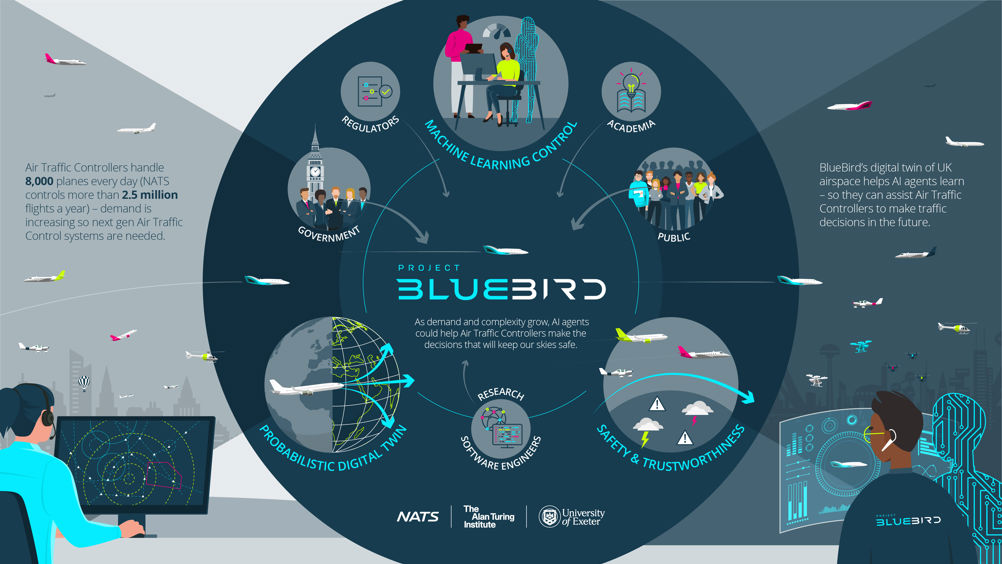
Enter Project Bluebird — a boldly ambitious, £13.7 million research initiative backed by the Engineering and Physical Sciences Research Council (EPSRC). This groundbreaking venture unites over 90 specialists drawn from NATS (the UK's leading air navigation service provider), the prestigious Alan Turing Institute, and the University of Exeter. Together, they are engineering an AI-powered approach to air traffic control that could set an entirely new international standard for intelligent automation in high-stakes environments. Real-world trials are earmarked for spring 2026, representing a watershed moment in how the UK — and potentially the world — manages its airspace.

The Engine Behind the Innovation
Central to Bluebird's technical ambition is an advanced, probabilistic digital twin: a sophisticated virtual replica of a live airspace environment that goes far beyond what conventional flight simulators can offer. Rather than simply modelling static conditions, this platform weaves together real operational procedures with both live and archival traffic data. Crucially, its probabilistic architecture accounts for the inherent unpredictability of real-world flying — shifting weather patterns, variable flight schedules, and unexpected operational demands — allowing researchers to stress-test AI behaviour across everything from routine daily operations to rare and complex emergency scenarios.
The platform has been designed with both scalability and practicality firmly in mind. It can be deployed via the cloud or run locally, supports multiple simultaneous users, and faithfully reproduces the visual layout and tools found in an actual operations room. This makes it an extraordinarily versatile resource — equally valuable for pure research, controller training, operational prototyping, and system evaluation.
Underpinning the platform are several genuinely novel technical advances. A physics-informed machine learning model of aircraft performance cleverly fuses the reliability of established physical laws with the flexibility of data-driven learning — yielding a 40 per cent improvement in predictive accuracy compared with current industry benchmarks. The project has further developed automated pipelines that harness large language models to generate training scenarios, alongside graph neural networks capable of anticipating the workload demands placed on air traffic controllers.
The AI development team has cast a wide methodological net, investigating reinforcement learning, Monte Carlo tree search, constrained optimisation, and graph-based computational approaches. A consistent thread running through all of this work is a commitment to transparency: AI agents display their decision-making plans visibly within the digital twin environment, allowing experienced controllers to observe, interrogate, and give structured feedback on AI behaviour.
A World-First Assessment Framework
Perhaps the most consequential innovation to emerge from Project Bluebird is one that addresses not just capability, but credibility. For AI to be trusted in safety-critical environments, it must be evaluated rigorously — and on terms that mean something to the humans who work alongside it.
The team has developed the world's first AI Air Traffic Controller Competency Assessment Framework: a structured evaluation system that holds AI agents to the same performance criteria applied to human trainee controllers during their professional development. By embedding NATS training scenarios directly into the digital twin, the framework enabled a landmark assessment conducted in March 2025, during which NATS instructors carried out more than 60 hours of hands-on evaluation. The AI agents successfully met the required standard in three out of four assessed competency areas — a remarkable result for a first formal evaluation of this kind. The team is targeting a clean sweep across all four competencies before mid-2026.
Live shadow trials — in which AI agents will operate in parallel with human controllers in a genuine operational setting — are planned to commence in 2026, marking the first time such a system will be tested against the full complexity of real-world airspace.
A Collaboration Built on Mutual Respect
The ambition behind Bluebird from the outset was a frank acknowledgement that neither academia nor industry could crack this challenge independently. Academic AI research, however sophisticated, often lacks the grounding in operational reality needed for deployment in regulated, safety-critical settings. Meanwhile, industry expertise — however deep — cannot alone generate the fundamental breakthroughs required to manage the airspace of the future.
Bluebird bridges that gap deliberately and structurally. Each of the project's three research themes is co-led by both an academic and an industry expert, ensuring that the drive for innovation and the demand for practical, safe solutions are held in productive tension rather than allowed to diverge.
Reconciling the different rhythms and values of academia and industry has required patience and candour. Researchers are drawn to novelty and publication; operational professionals prioritise robustness, safety, and implementability. Rather than papering over these differences, the project has treated them as a source of creative friction — pushing both sides toward outputs that are simultaneously rigorous and genuinely deployable.
A powerful unifying measure has been a shared investment in domain knowledge. Every member of the project — data scientists, AI engineers, mathematicians — completed on-site training at NATS' professional college, the same institution that trains real air traffic controllers. This common foundation has ensured that technical work remains rooted in operational reality, dramatically reducing the risk of well-intentioned research missing the point entirely.
Geographic dispersion across the UK has been managed through regular in-person workshops and clear governance protocols, maintaining cohesion across a large and distributed team.
Real-World Impact, Already Underway
The practical benefits of the project are already taking shape. The BluebirdDT software suite — integrating the digital twin, benchmark AI agents, a visualisation environment, and a training and evaluation platform — gives the UK its first genuinely safe and operationally realistic testbed for developing and validating new automation concepts before they ever touch live airspace.
Embedding BluebirdDT within NATS' innovation infrastructure has cut the time and cost of prototype development by as much as 80 per cent. A cloud-based version is already operational and has been adopted as part of NATS' recruitment and selection process, supporting the screening of thousands of trainee controller applicants annually. Extensions into airspace design — including contributions to the UK Airspace Design Strategy and feasibility work connected to the proposed expansion at Heathrow — are already being planned.
The system's trajectory prediction capability has drawn particular attention. Independent analysis suggests it could unlock capacity increases of up to 40 per cent without any reduction in safety standards. Beyond capacity, accurate route forecasting opens the door to more environmentally conscious routing decisions, including the ability to steer aircraft away from persistent contrail formation — a phenomenon responsible for nearly half of aviation's total climate impact. This gives the project a meaningful role in the broader decarbonisation of the sector.
Bluebird is also quietly shaping the regulatory landscape. By giving the Civil Aviation Authority access to a working, evidence-based platform rather than purely theoretical arguments, NATS is better positioned to help regulators develop frameworks that are ready for an AI-enabled aviation future.
Building the Next Generation
Skills development sits at the heart of the project's legacy. More than 100 individuals have contributed directly, including 15 doctoral internships and 12 PhD studentships — with dedicated provision for neurodiverse researchers. A new Centre for Doctoral Training at the University of Exeter, established in partnership with NATS, will ensure a lasting pipeline of specialists at the intersection of artificial intelligence and air traffic management.
An open-source release of BluebirdDT is planned for April 2026, alongside an international machine learning competition designed to draw the global research community into tackling real air traffic control challenges — firmly establishing the UK as a world leader in the future of aviation automation.
Project Bluebird was recognised as the winner in the Information, Data and Connectivity category at the 2025 Engineer C2I Awards.