

In commemoration of the 47th anniversary of the June 16 uprising, the Gauteng government has launched its Nasi Ispani (Here is a job) campaign offering 8,000 jobs in the provincial government.
According to Gauteng Premier Panyaza Lesufi, the campaign represents the provincial government’s commitment to intensifying efforts to curb unemployment and raise awareness about existing job openings.
The campaign comes against a backdrop of a 34.3% official unemployment rate in the province, rising to 39.6% under the expanded unemployment rate definition, as recorded by Statistics SA’s first-quarter 2023 Labour Force Survey.
Range of posts
At least 8,000 vacancies are available across all Gauteng provincial departments and entities until 14 July 2023. The posts range from drivers, receptionists, cleaners, artisans, security managers, safety officers, electricians, social workers, and engineers to managers and advisers.
As per the advertisement flyers, all jobs are to be permanent, except where indicated.
For Youth Day, the Premier, Members of the Executive Council(MECs), human resource officials and data capturers were present at 22 walk-in centres across the province to assist applicants apply for jobs.

Premier Panyaza Lesufi greets job seekers at Nasrec on 16 June 2020. (Photo: Kabelo Mokoena)
Thousands of residents – young and old – braved the chilly Gauteng weather to apply for the jobs. Others opted to apply from the comfort of their homes via an online platform.
Daily Maverick was at Nasrec Expo Centre, where almost 5,000 residents from the Johannesburg region waited in a long queue, some having been there since as early as 6am. Many were tired and hungry but determined to submit their applications even if it meant spending the night there.
Ready and willing to take any job
Charles (43), from Diepkloof in Soweto, told Daily Maverick he had never worked a day in his life. He said he came out to Nasrec to submit an application in the hopes of becoming employed. Because of his level of desperation, he said he was ready and willing to take any legitimate job the government had to offer.
“All my adult life I have been trying to get a job with no luck and at some point fell victim to a number of job scams,” he said.
“Today I am here to try my luck like everyone else in the queue, but really all hope is gone. The walk-in centre closes at 4pm, which is sad because it might mean I can’t apply. I am an old man and it’s hard to always be asking for assistance from my mother. By now I should be the one taking care of her, my two sons and my grandchild. Even the Covid grant of R350 cannot keep me afloat. It is really difficult,” he told Daily Maverick.

Some of the applicants had been waiting in the queue since 6am. (Photo: Kabelo Mokoena)
Portia Kubelo (30), from Lenasia South in Hospital Hills. is a mother of two. She was one of the many in the queue hoping to submit her application. Kubelo told Daily Maverick she had been unemployed since 2018 and had been surviving on her children’s and siblings’ social grants.
“I have been in the queue since 6am and am still here. It seems the line is stagnant. though I am hopeful because getting this job will better my life, and that of my two children and siblings, because being the eldest I bear the responsibility of taking care of them.”
Job hunting for three years
Lesedi Tsotetsi (23), a public relations student at Unisa, said a single response from the many applications she had submitted would give her solace.
“I have been job hunting for three years since completing matric with no luck … I am just hoping that I get at least one response for everything I have applied for. It’s a good thing that the government is doing this, but I just hope it’s real and they keep their word. I would be so happy to get a job and it will change my life in the sense that I will be able to finance my studies and make a contribution at home.”
By 4pm the job application queue at Nasrec was still long with more applicants joining. While many others flooded the online platform to the point where the page was unresponsive for many, indicating the dire need for jobs.
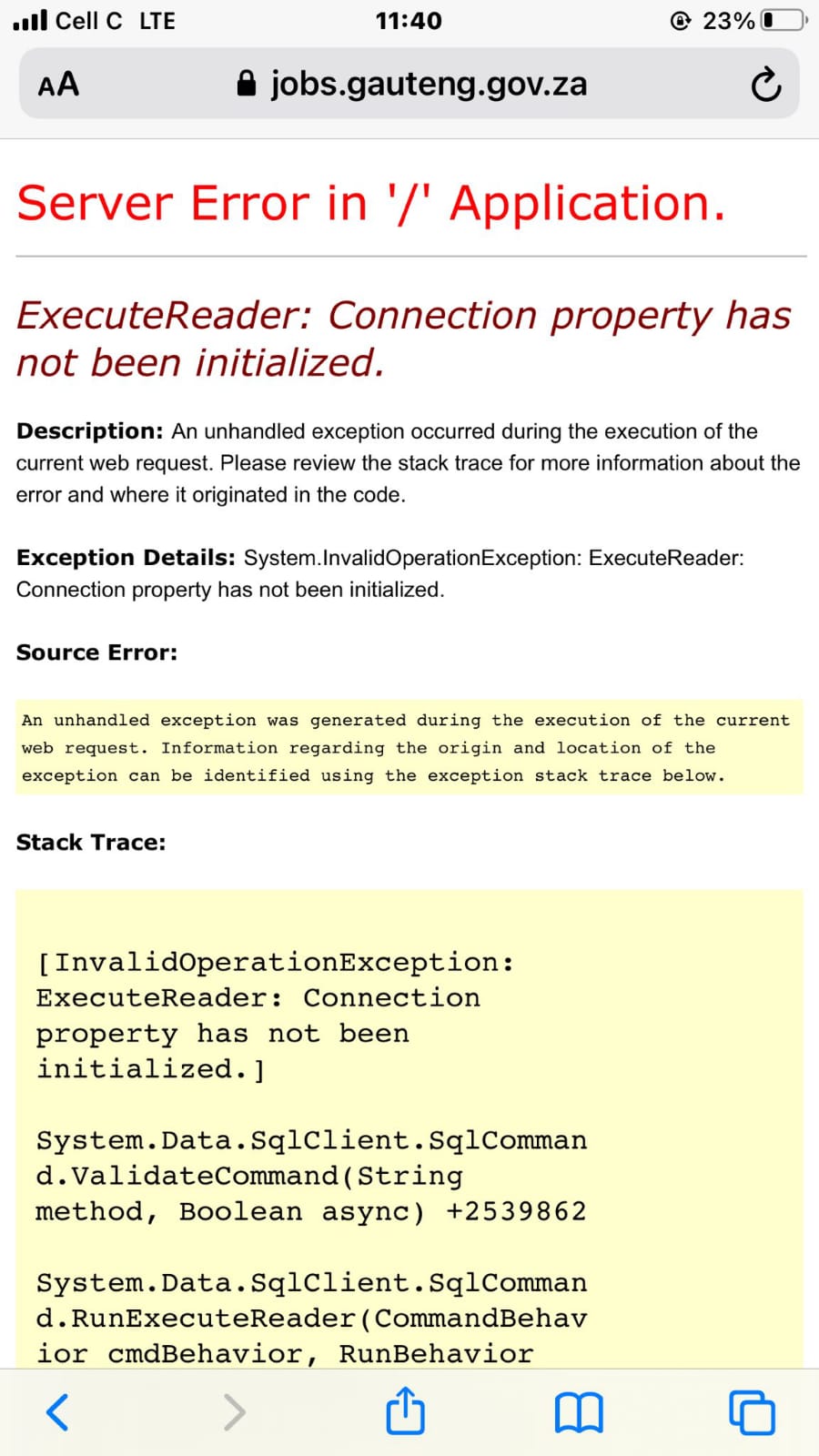
A screenshot of the It’s the online application showing an error code on their website. It keeps crashing because of the large number of people trying to apply online.
After successfully submitting an application, Sesi Mokgaetje said: “We honestly hope for a free and fair recruitment process.”
According to the online portal, applicants can expect a response within three months. DM