
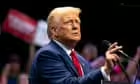

In a high-profile event held in Savannah, Georgia, former President Donald Trump aimed to present his vision for revitalizing the American economy. However, much of his speech veered away from purely economic topics, instead focusing heavily on immigration as a scapegoat for a range of problems, from drug overdoses to job losses. This article delves into the details of Trump’s speech, examining how immigration was framed in the context of economic development, the reaction of the crowd, and the broader implications of conflating immigration with economic challenges.
The Intended Focus: Economic Development and Industrial Revival
The event in Savannah was initially designed to promote policies aimed at ushering in what Trump’s campaign calls a “new age of American industrialism.” His prepared remarks highlighted plans to revive American manufacturing, reduce energy costs, and foster economic growth. Trump emphasized the country’s abundant natural resources, skilled workforce, and leading companies as foundations for economic resurgence.
Central to his economic agenda was the promise to restore manufacturing to the prominence it held 50 years ago. He pledged to block the sale of US Steel to foreign interests and proposed incentives for companies to build manufacturing facilities on federal land. These initiatives were positioned as strategies to stimulate domestic production and job creation.
Trump also discussed tax policies, proposing a corporate tax cap of 15% for companies that manufacture products within the United States. This proposal builds upon the 2017 Tax Cuts and Jobs Act, which lowered the corporate tax rate to 21%, and aims to further incentivize domestic production and investment.
Immigration as a Central Theme Despite Economic Agenda
Although the event was meant to focus on economic development, a significant portion of Trump’s speech shifted towards immigration. He framed undocumented immigrants as the root cause of numerous problems affecting the economy and society. From fentanyl overdoses to crime rates and job competition, migrants were repeatedly singled out as scapegoats.
Trump justified this focus by claiming immigration is a critical part of economic development, asserting that border security and immigration policies directly impact the nation’s economic health. His remarks were met with enthusiastic support from the crowd, including chants like “Close the border!” which highlighted the strong anti-immigration sentiment among attendees.
This pivot from economic policy to immigration rhetoric reflects a broader trend in Trump’s campaign strategy, where immigration is used to galvanize his base and link economic concerns to border security and enforcement.
Crowd Reactions and Political Messaging at the Georgia Event
The event drew approximately 2,500 attendees, many of whom responded positively to Trump’s immigration-focused remarks. Loud cheers and chants erupted when Trump criticized undocumented immigrants for taking jobs and contributing to social issues. This reaction underscores the resonance of immigration as a campaign issue among Republican voters in Georgia.
Among the audience were supporters who expressed frustration with the availability of goods and services, linking these challenges to immigration. For instance, some attendees claimed that the presence of immigrants was responsible for shortages in grocery stores and the allocation of social benefits such as loans, healthcare, and driver’s licenses.
This crowd dynamic highlights how immigration narratives are intertwined with economic grievances among certain voter groups, shaping their perceptions of both the economy and immigration policy.
Contrasts with Local Economic Developments in Georgia
Interestingly, while Trump criticized electric vehicles and foreign investments, Georgia has been actively attracting major projects in these sectors. A notable example is the $5.4 billion Hyundai electric car plant, expected to employ 8,500 workers. The plant has received praise from Georgia’s governor, Brian Kemp, reflecting a commitment to modern industrial growth.
Trump’s speech notably omitted mention of such developments or Governor Kemp, focusing instead on bashing electric cars—except those made by Elon Musk, a Trump supporter. This selective messaging contrasts with on-the-ground economic realities in Georgia, where investment in advanced manufacturing and green technology is expanding.
This disconnect between Trump’s rhetoric and local economic initiatives may influence voters’ perceptions, particularly in regions where such projects contribute significantly to employment and economic vitality.
Linking Immigration to National Security and Personal Grievances
Beyond economic arguments, Trump’s speech included references to national security concerns and personal experiences. He recounted surviving an assassination attempt and suggested that divine intervention played a role in his survival, framing his mission as a patriotic duty to ‘bring America back.’
He also questioned the intelligence and patriotism of Vice President Kamala Harris, weaving immigration and political critiques together. This blending of personal grievances and political attacks served to rally his base and reinforce a narrative of threat and urgency.
Such rhetoric extends beyond policy discussion, tapping into emotional and symbolic themes that resonate with supporters, but also polarize public discourse around immigration and national identity.
The Broader Political Context: Tax Policy and Economic Promises
Trump’s economic proposals, including tax cuts for domestically producing corporations, are positioned as competitive advantages to lure industries back to the United States. He promised to halve Americans’ energy bills and prevent global conflicts, tying economic prosperity to national security and stability.
These promises build on previous Republican tax reforms but also contrast with Democratic proposals. For example, Vice President Harris has advocated raising the corporate tax rate to 28%, emphasizing different approaches to economic growth and fiscal policy.
The debate over tax policy and economic strategy remains central to the 2024 presidential race, with immigration rhetoric serving as a key element in framing economic challenges and solutions.
Implications for Voters and the 2024 Election Landscape
Trump’s visit to Georgia marked his first since early August and came shortly after Harris held a large rally in Savannah. The contrasting turnout and messaging reflect the competitive nature of the state, which is considered a battleground in the upcoming election.
By linking immigration to economic issues, Trump aims to consolidate support among voters concerned about jobs, inflation, and social services. However, this approach risks alienating voters who view immigration as a complex issue that requires nuanced policy solutions.
The framing of migrants as scapegoats may energize segments of the Republican base but also intensifies the polarization surrounding immigration and economic policy, shaping voter attitudes and campaign narratives in the months ahead.
Conclusion: The Interplay of Immigration and Economic Rhetoric in Trump’s Campaign
The Georgia event highlighted how immigration continues to be a central theme in Trump’s campaign, often overshadowing the economic agenda he initially set out to promote. By attributing economic and social challenges to migrants, Trump reinforces a familiar narrative that resonates with his core supporters.
While economic revitalization remains a key promise, the blending of immigration rhetoric with economic policy complicates the discourse, potentially limiting constructive debate on both fronts. This strategy reflects broader political dynamics where immigration is leveraged as a potent campaign issue.
As the 2024 election approaches, the effectiveness of this narrative in swaying voters remains to be seen, particularly in diverse and economically evolving states like Georgia.
Conclusion
Donald Trump’s speech in Savannah, Georgia, exemplifies how immigration continues to serve as a central, and often divisive, theme in his campaign rhetoric. Despite the event’s stated focus on economic revitalization, Trump’s persistent scapegoating of migrants for a host of societal issues illustrates a strategic approach to energize his base by linking immigration tightly with economic anxieties. This blending of topics reflects the broader political landscape where immigration remains a potent and polarizing issue shaping voter perceptions and electoral dynamics. As the 2024 election draws nearer, the effectiveness and consequences of this approach will be critical to watch, especially in battleground states like Georgia where economic development and demographic changes intersect.
Originally reported by theguardian.com. Adapted for our readers.