
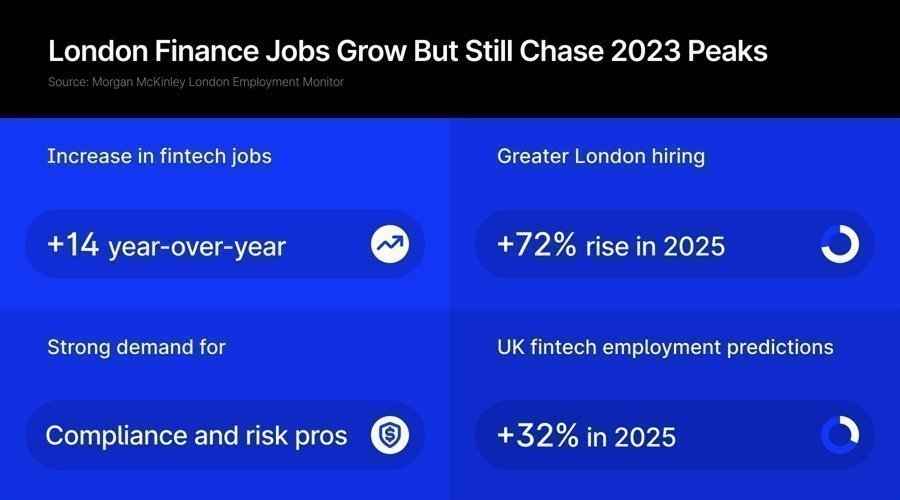

The London finance job market shows signs of recovery, with fintech-driven hiring up 14% year-on-year according to Morgan McKinley's latest data. Yet permanent roles remain below 2023 peaks, and contract work has softened as firms favour stability. For freelancers and consultants, this creates both challenge and opportunity. While some employers pause temporary hiring, the demand for specialised expertise in compliance, risk, and fintech innovation persists. This article explores how independent professionals can adapt their approach, target high-growth niches, and build resilient careers in Britain's evolving financial landscape and beyond.
Understanding the Current Finance Hiring Landscape
London's financial services sector is experiencing a cautious rebound. Data from Morgan McKinley shows a 3% quarterly rise in job vacancies during Q2 2025, building on a 12% seasonal increase in Q1. Year-on-year, finance and fintech openings are up 14%, signalling gradual recovery from last year's downturn. However, hiring levels have not yet returned to the highs seen in 2023, reflecting ongoing employer hesitation.
Several factors contribute to this measured pace. Global market volatility, Middle Eastern tensions, and uncertainty around US trade policies have dampened business confidence since the start of the year. Domestically, the UK government's increase in employer National Insurance contributions has added to cost pressures, making firms more reluctant to expand teams. Many organisations are prioritising long-term efficiency over short-term headcount growth, which directly impacts contract and freelance opportunities.
Where Demand Is Strongest: Fintech, Compliance, and Risk
Despite broader market caution, specific areas within finance are driving hiring growth. Fintech companies are leading the charge, with Morgan McKinley projecting a 72% jump in fintech hiring across Greater London throughout 2025. This would make it the UK's fastest-growing sector for recruitment. The surge reflects continued investment in digital banking, payment innovation, and blockchain applications.
Within this growth, compliance and risk roles are seeing particularly strong demand. As financial regulations evolve and firms navigate complex international markets, expertise in anti-money laundering (AML), know-your-customer (KYC) protocols, and regulatory reporting remains essential. Similarly, risk management professionals who can assess credit, operational, and market risks are increasingly valued as firms seek to strengthen resilience against economic shocks.
Adapting Your Freelance Approach in a Risk-Averse Climate
With firms favouring permanent staff over temporary contractors since Easter, freelancers need to adjust their positioning. Rather than competing for short-term cover roles, focus on becoming a trusted advisor for specific projects. Emphasise how your expertise can deliver measurable outcomes—such as implementing a new compliance framework, upgrading legacy fintech systems, or conducting a risk audit—without adding to permanent payroll.
Highlight your ability to work remotely and deliver results quickly. Many London-based firms now operate hybrid models and are open to engaging international talent for niche tasks. Position yourself as a solution to temporary capacity gaps during busy periods, regulatory reporting deadlines, or technology migrations, rather than a replacement for full-time staff.
Building Skills That Command Premium Rates
To stand out in a competitive market, invest in skills that align with London's finance growth areas. For fintech, consider certifications in digital payments, regtech, or basic programming languages like Python or SQL used in financial analysis. Compliance professionals might pursue qualifications from the International Compliance Association (ICA) or specialist training in GDPR, MiFID II, or the FCA's Consumer Duty.
Risk management consultants can benefit from certifications in operational risk (such as those offered by the Global Association of Risk Professionals) or cybersecurity risk frameworks. Crucially, combine technical knowledge with strong communication skills—the ability to explain complex regulations or risks in plain English to non-specialist stakeholders is highly valued by clients seeking freelance support.
Pricing and Negotiation Strategies for Finance Consultants
In a market where firms are cost-conscious, transparent and value-based pricing builds trust. Instead of hourly rates alone, consider offering fixed fees for defined projects—such as completing a regulatory gap analysis or configuring a compliance monitoring system. This helps clients budget accurately and reduces perceived risk.
When negotiating, focus on the return on investment your work provides. For example, a freelance compliance consultant who helps a fintech avoid regulatory fines or secure authorisation faster is delivering clear financial value. Be prepared to discuss how your expertise saves time, reduces errors, or enables faster market entry. Keep records of past outcomes to strengthen your case during rate discussions.
Leveraging Remote Work and Global Opportunities
While London remains a hub for finance innovation, freelancers are not limited to geography. The rise of remote work means UK-based consultants can serve clients across Europe, North America, and increasingly, Africa and Asia. Nigerian finance professionals, for instance, can offer valuable insights into emerging markets while supporting London firms expanding internationally.
Use platforms that cater to specialised finance talent, and maintain a strong online presence showcasing your certifications, case studies, and client testimonials. Consider joining professional networks such as LinkedIn groups focused on fintech compliance or freelance finance forums. These connections often lead to referrals and repeat work, which is vital in a market where trust and reputation carry significant weight.
Navigating the Gig Economy with Resilience
The gig economy in finance rewards specialisation and reliability. Rather than chasing volume, aim to build a portfolio of repeat clients who value your niche expertise. Diversify across sectors where possible—for example, serving both fintech startups and established banks in different compliance areas—to reduce reliance on any single client.
Stay informed about macroeconomic trends that affect hiring, such as changes to UK employment policy or shifts in global investment flows. However, avoid letting external uncertainty paralyse your business development. Instead, use quieter periods to upskill, refine your service offerings, and strengthen your professional network. Consistency and adaptability are key to long-term success in freelance finance.
What this means
London's finance sector is healing gradually, with growth concentrated in specific, high-value areas. For freelancers and consultants, this environment demands focus, adaptability, and a commitment to continuous learning. By aligning your services with the demand for fintech innovation, compliance expertise, and risk management, you can build a sustainable independent career. The market may favour caution, but it still rewards those who deliver clear, specialist value—whether from a London co-working space or a remote office halfway across the world.
Originally reported by financemagnates.com. Adapted for our readers with AI assistance.


