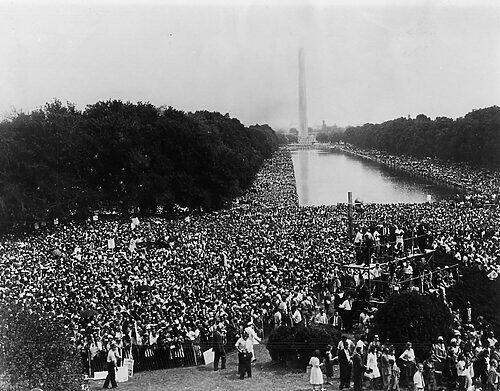

The 1963 March on Washington for Jobs and Freedom drew roughly 250,000 people to the Lincoln Memorial. Rev. Martin Luther King Jr. delivered his iconic "I Have a Dream" speech, and civil rights leaders including John Lewis, then 23 and chair of the Student Nonviolent Coordinating Committee, addressed the crowd. Yet not a single woman gave a substantive speech that day. Rosa Parks offered exactly 29 words of welcome. Daisy Bates, NAACP chapter president who led the Little Rock school integration strategy, spoke briefly. Mahalia Jackson performed the national anthem. Women — central to the movement's organizing, fundraising, and grassroots mobilization — were rendered invisible on the main stage. Sixty years later, the "She Speaks" assembly organized by Repairers of the Breach is correcting that historical silence, platforming Black clergywomen to address the same economic justice issues — fair wages, voting rights, healthcare access, ending racial discrimination — that drove the original march.
The 1963 March: A Platform Without Women
The 1963 March on Washington for Jobs and Freedom drew roughly 250,000 people to the Lincoln Memorial. Rev. Martin Luther King Jr. delivered his iconic "I Have a Dream" speech, and civil rights leaders including John Lewis, then 23 and chair of the Student Nonviolent Coordinating Committee, addressed the crowd. Yet not a single woman gave a substantive speech that day. Rosa Parks offered exactly 29 words of welcome. Daisy Bates, NAACP chapter president who led the Little Rock school integration strategy, spoke briefly. Mahalia Jackson performed the national anthem. Women — central to the movement's organizing, fundraising, and grassroots mobilization — were rendered invisible on the main stage.
"She Speaks": A Corrective Assembly
On August 28 — the march's 60th anniversary — the civil rights organization Repairers of the Breach hosted "She Speaks," a mostly online assembly by and for women, particularly Black clergywomen. Founded in 2015 by Rev. William Barber after North Carolina's Moral Monday movement, Repairers of the Breach designed the event to highlight women's voices on the same issues that drove the original march: economic justice, fair wages, voting rights, healthcare access, and ending racial discrimination. The formal anniversary rally occurred two days earlier, on August 26, with leaders including Andrew Young, Rev. Al Sharpton, and members of King's family. "She Speaks" was deliberately separate — a correction, not a commemoration.
Women Now Leading Major Denominations
The speaker lineup reflects recent breakthroughs in Black Christian denominations. The heads of the United Church of Christ, the Disciples of Christ, and the National Council of Churches — all women, all recently appointed or elected — addressed the audience, some from the Lincoln Memorial steps and others online. MSNBC host Joy Reid and Black Voters Matter co-founder LaTosha Brown also spoke. As Rev. A. Kazimir Brown, executive director of Repairers of the Breach, stated: "I really feel that it's important to be able to lift up women's voices across the country to speak on the variety of issues currently facing this country." The emphasis was explicitly not on women's rights as a separate category, but on the structural inequalities — poverty, healthcare, voting suppression, racial discrimination — that disproportionately affect Black communities.
Rev. Hanna Broome: From $4.25 an Hour to the Pulpit
Rev. Hanna Broome, presiding elder in the AME Zion Church and director of religious affairs at Repairers of the Breach, embodies the economic precarity the assembly addresses. Homeless and pregnant with twins at 14, she dropped out of school and worked at Burger King in South Carolina for $4.25 an hour — the late-1980s minimum wage. Even that wage barely fed her family of three. "That literally would have wiped us out," she said of the prospect of serious illness. Now in her late 40s with three children and six grandchildren, she earned a doctorate of ministry from Drew University in May 2023. "I refuse to allow my grandchildren to have the same fight," she said. "So as long as there's breath in me, I'm gonna be fighting." Her story illustrates how low wage floors — the federal minimum remains $7.25 — perpetuate intergenerational poverty. A New York Times analysis found about 68,000 Americans on average earned the federal minimum wage in the first seven months of 2023.
Rev. Shyrl Uzzell: Justice Beyond Sunday Morning
Rev. Shyrl Uzzell, 67, was installed as pastor of Greenleaf Christian Church in Goldsboro, North Carolina, after Rev. Barber stepped down in summer 2023 to direct the Center for Public Theology & Public Policy at Yale Divinity School. Her congregation has accepted her leadership, but she reminds them that community membership is "more than coming to church on Sunday morning. It also involves fighting for justice." Uzzell helped plan the "She Speaks" assembly: "We have to be concerned about the things that concern the community." Her ministry reflects the assembly's core argument: faith leadership must engage structural injustice — the erosion of voting rights protections, the Supreme Court's overturning of abortion rights, the end of affirmative action in college admissions, and the stagnant federal minimum wage.
Progress and Persistent Structural Inequality
Women have made gains in most major Black Christian denominations, where doctrinal bars to ordained women in leadership have largely fallen. Yet structural inequality persists. The "She Speaks" speakers connected their denominational leadership to broader systemic fights: raising the federal minimum wage, restoring voting rights protections weakened by the Supreme Court's 2013 Shelby County v. Holder decision, defending reproductive rights after Dobbs, and resisting the rollback of affirmative action. These are the same economic and racial justice issues that echoed at the Lincoln Memorial in 1963 — now voiced by women who were excluded then.
Key Takeaways
Conclusion: The Long Arc of Correction
The "She Speaks" assembly models how marginalized voices build power: by organizing across denominations, platforming each other, and demanding structural change rather than individual accommodation. The women excluded from the 1963 podium did not stop organizing. They built institutions, mentored generations, and eventually claimed leadership of the very denominations that once silenced them. Their correction is instructive for any movement: history's corrections are slow, but they are built through sustained collective action — not by waiting for an invitation to the podium, but by building a new one.
What this means
The "She Speaks" assembly models how marginalized voices build power: by organizing across denominations, platforming each other, and demanding structural change rather than individual accommodation. The women excluded from the 1963 podium did not stop organizing. They built institutions, mentored generations, and eventually claimed leadership of the very denominations that once silenced them. Their correction is instructive for any movement: history's corrections are slow, but they are built through sustained collective action — not by waiting for an invitation to the podium, but by building a new one.
Originally reported by gestyy.com. Adapted for our readers with AI assistance.