
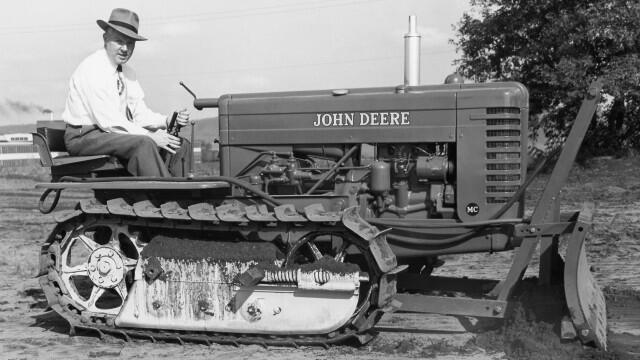

In 1949, John Deere embarked on a journey that would significantly shape the construction and earthmoving industry by introducing its first MC Dozer. Over the past 75 years, John Deere has consistently pushed the boundaries of bulldozer technology, blending durability, power, and innovation to meet the evolving demands of contractors worldwide. Starting production in Dubuque, Iowa, the company’s bulldozer lineup has undergone remarkable transformations, from early hydraulic breakthroughs to today’s cutting-edge smart control systems. This article delves into the rich history, technological milestones, and future prospects that underscore John Deere’s commitment to advancing bulldozer performance and jobsite efficiency.
The Early Years: Establishing a Foundation in Bulldozer Manufacturing
John Deere’s foray into bulldozer manufacturing began in 1949 with the MC Dozer, produced in Dubuque, Iowa. This initial model laid the groundwork for the company’s reputation in the heavy equipment sector by emphasizing reliability and ruggedness. Early John Deere dozers were designed to meet the demanding needs of contractors who required machines capable of enduring tough jobsite conditions.
Throughout the 1950s, John Deere focused on refining dozer capabilities, culminating in the 1958 introduction of the 440 Crawler Dozer. This model was notable for being the industry’s first all-yellow machine specifically built for industrial applications, featuring an all-hydraulic system and a six-way power-angle-tilt blade. These innovations set new standards for versatility and efficiency in earthmoving.
By the mid-1960s, John Deere continued to innovate with the introduction of T-Bar blade controls and the launch of integral machines like the JD350 and JD450. These models were uniquely configured as dozers or loaders, catering to diverse jobsite applications and further solidifying Deere’s foothold in the bulldozer market.
Pioneering Technological Breakthroughs in the 1970s and 1980s
The 1970s marked a significant leap for John Deere with the adoption of dual-path hydrostatic drive technology in 1976, making Deere the first North American manufacturer to implement this system on its dozer lineup. This innovation enhanced machine maneuverability and operator control, providing superior performance on challenging terrains.
Advancing into the 1980s, John Deere introduced full powershift transmission models such as the 400G, 450G, 550G, and 650G. These models offered four forward and four reverse speeds, expanding operational flexibility and efficiency. The introduction of these transmissions represented Deere’s commitment to integrating power and precision for jobsite productivity.
During this period, Deere’s bulldozers also benefited from improved operator ergonomics and machine durability, with continuous refinements to the undercarriage and blade systems. These enhancements ensured that John Deere dozers could withstand prolonged heavy-duty use while maintaining operator comfort.
Entering the Modern Era: The 1990s to Early 2000s
The late 1990s saw John Deere further entrench its technological leadership with the reintroduction of dual-path hydrostatic drive on models like the 450H, 550H, and 650H. This system remains a cornerstone of Deere’s bulldozer performance, delivering smooth power delivery and precise control that contractors depend on.
In 2001, Deere launched its largest dozer to date, the 1050C, which set the stage for subsequent innovations in power, efficiency, and operator comfort. The 1050C became a flagship model, embodying the company’s dedication to meeting the needs of large-scale construction and mining operations.
This era also saw increased focus on integrating electronics and controls to optimize machine performance. John Deere began incorporating advanced monitoring systems and operator-friendly interfaces, which helped reduce downtime and improve productivity across various jobsite conditions.
Innovation Acceleration: Breakthroughs in Speed and Control (2010-2015)
The 2010 debut of the 764 High-Speed Dozer marked a major milestone as the first new bulldozer design in decades to emphasize speed. With travel speeds reaching up to 16 mph, this model significantly reduced cycle times and improved overall jobsite efficiency, especially in applications requiring rapid movement between tasks.
During this period, John Deere invested heavily in enhancing machine control technologies. The integration of SmartGrade technology, starting in 2016 on the 700K model, allowed for factory-installed 3D grade control. This innovation simplified grading tasks, minimized rework, and empowered operators with precise blade positioning guided by GPS and sensors.
These advances not only boosted productivity but also contributed to safer jobsite environments by reducing the need for manual staking and grade checking. John Deere’s focus on blending mechanical excellence with digital solutions began to set new industry standards.
Advancements in Operator Comfort and Machine Stability
Recognizing the critical role of operator comfort in productivity, John Deere introduced the suspended double-bogie undercarriage on the 1050K in 2021. This innovation dramatically reduced peak cab vibrations by up to 75 percent, significantly enhancing operator endurance and reducing fatigue on long shifts.
Coupled with ergonomic cab designs featuring improved visibility, climate control, and intuitive controls, Deere’s dozers have become environments that support operator focus and efficiency. These improvements have been essential in attracting skilled operators and maintaining high levels of jobsite performance.
Machine stability was also enhanced through structural upgrades and advanced suspension technologies, ensuring that even the largest dozers maintain balance and traction on uneven or soft ground. These features have allowed operators to work confidently in challenging conditions.
Recent Technological Innovations: Smart Features Transforming Grading
John Deere’s 2023 rollout of the EZGrade feature represents a leap forward in assisting operators with manual grading tasks. EZGrade automates small blade corrections, enabling smoother finish passes and reducing the need for expert operator skill to achieve professional-grade results.
This technology complements existing systems like SmartGrade and Slope Control, which was introduced in 2020 to help operators maintain consistent mainfall and cross slope during grading. Together, these features reduce rework, improve accuracy, and accelerate project timelines.
By integrating these smart technologies directly from the factory, John Deere ensures seamless operation and maximizes uptime. This approach underscores Deere’s philosophy of combining rugged reliability with intelligent automation to meet modern construction demands.
Looking Ahead: The Future of John Deere Bulldozers
In 2024, John Deere upgraded the 1050 P-Tier model with the powerful JD14 (13.6L) engine, delivering enhanced horsepower and operational efficiency. This upgrade is part of Deere’s ongoing commitment to providing machines that balance power with environmental responsibility through optimized fuel consumption and emissions controls.
Looking forward, John Deere continues to invest in research and development aimed at integrating autonomous capabilities, advanced telematics, and further electrification into its bulldozer lineup. These innovations promise to revolutionize how contractors approach earthmoving tasks, emphasizing safety, precision, and sustainability.
As John Deere celebrates 75 years in the bulldozer market, its trajectory indicates a future where machines not only perform with unmatched strength but also leverage cutting-edge digital tools to transform construction sites into smart, connected ecosystems.
Conclusion
John Deere’s 75-year journey in bulldozer manufacturing is a testament to its unwavering commitment to innovation, quality, and customer-centric design. From the rugged MC Dozer to today’s sophisticated, tech-enabled machines, Deere has continuously evolved to meet the challenges of modern construction and earthmoving. By blending mechanical prowess with smart technologies, John Deere not only honors its rich heritage but also pioneers the future of bulldozers. As the company looks ahead, its focus on sustainability, automation, and connectivity promises to keep John Deere at the forefront of the industry for decades to come.
Originally reported by heavyequipmentguide.ca. Adapted for our readers.