
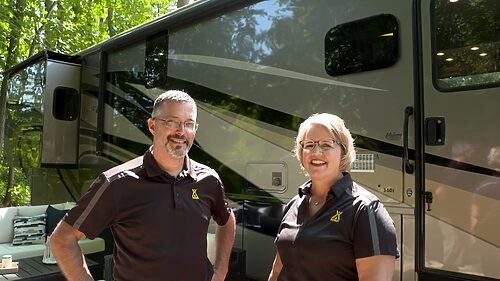

In an era when traditional career paths are increasingly questioned, Mark and Karla Lemoine's story offers a compelling case study for freelancers contemplating entrepreneurship. In 2016, Mark came home from his $200,000-a-year Michigan state government job and told Karla, a stay-at-home mother of four with two children in college, that he wanted to quit and buy a campground. Though lifelong campers with no business ownership experience, Karla agreed. Within six months, they found a franchised Kampgrounds of America site—the Coloma/St. Joseph KOA Holiday—in Benton Harbor, Michigan. They sold their house, car and belongings, withdrew savings and retirement funds, and took a bank loan to cover the $1.6 million purchase. The venture, now valued at $6 million and generating $1.2 million in annual revenue, illustrates how freelancers can assess risk, mobilise resources, diversify income and design work around personal values.
Assessing Risk and Opportunity Like a Business Owner
Mark's government salary came with hidden costs. Having survived corporate downsizings, he and Karla saw that steady pay cheques could not guarantee security. They evaluated their savings, retirement accounts and asset-liquidation potential before committing—similar to the financial runway audit freelancers should complete before reducing client dependence.
To fund the purchase, they sold their car and made $1,500 at a garage sale. They withdrew $20,000 from personal savings and Roth IRAs, took $200,000 from their 401(k)s, and added $180,000 from the sale of their Rockford, Michigan home. A bank loan covered the rest. After selling the house, they moved with two of their children into a four-bedroom apartment above the campground's general store. Their approach was calculated, not reckless. Freelancers contemplating similar shifts should stress-test assumptions: What is the true monthly burn rate? Which assets could be liquidated without compromising security? How would a six-month income drought affect the plan? Their story shows opportunity weighed against tangible safeguards.
Building Multiple Income Streams from Day One
When the Lemoines bought the campground, it had operated for 48 years. Cabins, tent zones and RV parking existed, but nearly everything needed updating. They renovated the bathrooms and rebuilt the general store, adding a robust café that improved the camper experience while generating ancillary income. This mirrors how freelancers can monetise adjacent skills: writers offering editing workshops, developers selling templates, or consultants hosting webinars.
The payoff required patience. In their first camping season, April to October, the park brought in $390,000, and they reinvested almost every penny. Revenue grew, and in 2021 they borrowed $300,000 to add five deluxe cabins, avoiding the mistake of draining reserves. That same year, a pandemic-era push to get people outside helped drive revenue to nearly $1 million, roughly $150,000 more than in 2020. For consultants, this illustrates phased investment—using early profits to fund scalable offerings rather than chasing every trend. Their glamping additions also show how to test new services with minimal viable offerings before scaling.
Designing Work Around Life, Not Vice Versa
After all four children moved out, the Lemoines bought a 34-foot RV and travel each offseason from November to March. The move was intentional lifestyle design, using seasonal business ownership to create flexibility unavailable in traditional employment. "We saw the wear and tear of working for corporate America on Mark and on our family dynamics," Karla says. "Now, owning our business, we're the bosses. We create and manage stress. For us, it's a healthier lifestyle."
Freelancers often cite autonomy as their primary motivator, yet many replace corporate schedules with equally demanding client calendars. The Lemoines' model shows how business ownership can enable temporal arbitrage: earning during peak seasons to fund periods of exploration or skill development. Knowledge workers might structure contracts to concentrate billable hours in high-demand months, reserving quieter periods for upskilling, passive income projects or travel. The couple also avoided a common freelancer pitfall: confusing busyness with productivity. By anchoring their identity to the campground's overall success rather than constant hourly output, they sidestepped the burnout cycle common in gig economies.
Reframing Security in the Ownership Economy
The Lemoines redefined financial security. Their current $150,000 combined salary is $50,000 shy of Mark's former corporate income, yet they are happier. They consider the campground their retirement fund, since they cashed out their 401(k)s to buy it. At today's $6 million valuation, selling the site would represent a significant return on investment. "It's not like we just went out on a big vacation or bought a house that we can't really afford," Mark says. "We bought something that produces income, so that debt doesn't scare us as much."
Traditional security metrics—a steady pay cheque and employer benefits—often mask fragility. Ownership models, whether equity in ventures or intellectual property in consulting frameworks, build resilience through appreciation and diversified exit options. Freelancers can apply the same logic when financing productive investments: a professional certification, course production or equipment that enables higher-value services. Evaluating debt by its capacity to generate income, rather than by its face value, makes leveraged growth sensible when tied to tangible outcomes.
Practical Steps for Freelancers Considering Entrepreneurial Leaps
Drawing from the Lemoines, here are actionable steps for freelancers. First, conduct a pre-mortem: list three ways your venture could fail and mitigation tactics, such as keeping a retainer client during transition. Second, map skill adjacencies: identify two or three services requiring limited upskilling that complement your core offering. Third, implement profit-first reinvestment: allocate a fixed percentage of monthly income to a fund for skill development or small-scale experiments.
Fourth, design seasonal rhythms: if your work has natural cycles, plan offseason activities six to nine months ahead. Fifth, calculate true hourly value by including business development, admin and upskilling when setting rates. Finally, build an asset mindset: regularly ask whether an activity is creating something you could sell, license or automate, shifting focus from trading time for money to creating enduring value.
What this means
The Lemoines' journey from government salaries to campground entrepreneurship offers freelancers a masterclass in resilient, purpose-driven careers. By treating their venture as a series of calculated experiments—from initial asset acquisition to ongoing revenue diversification—they show how independent workers can navigate uncertainty without sacrificing financial prudence or personal wellbeing. Their story underscores that true autonomy emerges not from rejecting structure, but from designing systems where work enhances life rather than depleting it. As Mark puts it, the couple describe the move as "a midlife reset where we just punch the button and did everything very different." In an economy where traditional security models are fraying, the freelancer who thinks like an owner—focusing on asset creation, strategic reinvestment and lifestyle alignment—is best positioned to thrive. The core lessons remain: assess risks thoroughly, diversify income intelligently, and never lose sight of why you chose independence in the first place.
Originally reported by festyy.com. Adapted for our readers with AI assistance.