
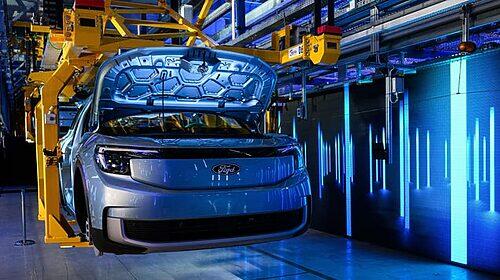

As the automotive industry rapidly transitions to electric vehicles, legacy automakers like Ford face immense pressure to adapt. Ford Motor Company, headquartered in Dearborn, Michigan, is undertaking substantial restructuring to balance its EV business’s financials. Recent reports reveal plans for significant salaried job cuts across its EV, gas-engine, and software divisions. Concurrently, the company is securing unprecedented federal loans to finance large-scale battery manufacturing facilities. This dual strategy aims to position Ford competitively in the evolving EV landscape while managing operational costs and capital expenditures. This article delves into the intricacies of Ford’s EV war chest, examining the financial, operational, and strategic maneuvers shaping its electric future.
The Financial Strain Behind Ford's EV Ambitions
Ford’s push into the electric vehicle market comes with substantial financial challenges. In 2022, the company reported operating losses of $2.1 billion in its EV division, a figure expected to widen in 2023. This loss reflects the high costs associated with EV production, including raw materials and advanced technology development. Additionally, Ford’s EV business lost nearly $60,000 per vehicle sold in the first quarter of 2023, underscoring the steep investments required before achieving profitability.
The automaker has revised its EV investment plans, increasing spending from an initial $30 billion to $50 billion between 2022 and 2026. This aggressive capital outlay aims to scale production capacity and technology development, with a goal of producing 2 million EVs annually by 2026—a massive leap from the 132,000 units produced in 2022. Despite the heavy losses, Ford forecasts an adjusted operating margin of 8% for its EV business, Ford Model e, by the end of 2026.
This financial strain is not unique to Ford. Most EV manufacturers, including legacy carmakers and startups, are grappling with inflation-driven raw material costs and the complexities of transitioning to software-driven vehicles. Ford’s financial challenges underscore the broader industry reality that profitability in the EV sector remains elusive in the short term.
Strategic Job Cuts: Streamlining Operations for the EV Era
To address its operational inefficiencies and align its workforce with EV priorities, Ford is planning significant job reductions. Sources indicate upcoming cuts across salaried positions in the EV, gas-engine, and software units, although exact figures remain undisclosed. These layoffs follow previous reductions, including 3,000 salaried and contract roles cut mostly in North America and India in August 2022, attributed to a skills gap in software and EV development.
Ford’s workforce restructuring mirrors moves by competitors like General Motors, which has offered voluntary buyouts to streamline operations. By focusing on employees with the requisite EV and software expertise, Ford aims to foster a more agile and technologically adept organization capable of accelerating EV innovation and production.
These job cuts are part of a broader strategy to reduce costs amid mounting losses and to pivot the company’s culture and capabilities toward electric and software-driven vehicles. While difficult, these measures are deemed necessary to ensure Ford’s long-term competitiveness in a rapidly evolving automotive market.
Federal Loans: A Crucial Boost for Battery Manufacturing
The U.S. government is playing a pivotal role in Ford’s EV strategy by extending substantial financial support. In June 2023, the Department of Energy announced a loan of up to $9.2 billion to BlueOval SK, a joint venture between Ford and South Korean battery manufacturer SK On. This funding will finance the construction of three battery factories in Tennessee and Kentucky, with production slated to begin in 2025.
This loan is the largest ever granted to a car manufacturer since the 2009 auto bailouts, tripling the loan extended to General Motors’ Ultium Cells venture. It reflects the Biden administration’s commitment to bolstering American EV and battery manufacturing to compete globally, especially against China’s dominance in the EV supply chain.
In addition to federal support, Ford has secured state-level incentives, including a $2.4 billion subsidy from Tennessee and $276 million in forgivable loans and training funds from Kentucky. These combined investments are critical for ramping up domestic battery production, a cornerstone for scaling EV manufacturing and reducing reliance on foreign suppliers.
BlueOval SK: The Battery Powerhouse Driving Ford's EV Future
BlueOval SK represents Ford’s strategic partnership to secure battery supply, a crucial bottleneck in EV production. By collaborating with SK On, Ford leverages South Korea’s advanced battery technology expertise while ensuring production occurs on U.S. soil. This joint venture is central to Ford’s plan to mass-produce EVs and meet its ambitious output targets by 2026.
The three planned battery plants will not only supply Ford’s electric trucks and SUVs but also create thousands of jobs in the manufacturing sector. BlueOval SK’s CEO Robert Rhee emphasized the importance of this project in strengthening domestic manufacturing, reducing carbon emissions, and supporting high-performance EV offerings.
The scale and timing of these battery factories are critical. With production beginning in 2025, Ford aims to mitigate current supply chain constraints and position itself as a leader in EV battery technology. This investment underscores the strategic importance of vertical integration in Ford’s EV roadmap.
Innovative EV Technologies: Ford’s Patent for a Rooftop Backup Battery
In addition to manufacturing scale, Ford is exploring innovative EV technologies to enhance vehicle functionality. Recently, the company filed a patent for a rooftop-mounted backup battery designed to extend driving range in areas lacking charging infrastructure. This concept could significantly improve the practicality of EVs for off-road enthusiasts and remote area drivers.
However, the proposed rooftop battery faces practical challenges, chiefly its considerable weight—potentially exceeding 1,000 pounds (453 kilograms). Such mass would require specialized equipment to handle and could risk structural integrity if not properly integrated into the vehicle design.
Despite these hurdles, the patent reflects Ford’s commitment to pushing technological boundaries in the EV sector. Innovations like the rooftop battery indicate the company’s focus on addressing real-world limitations of electric vehicles and enhancing customer experience.
Balancing Gas and Electric: Ford’s Dual Business Approach
In March 2023, Ford officially separated its EV and gas-engine businesses, recognizing the need to manage these two distinct operations independently. While the EV division is focused on rapid growth and innovation, the gas-engine business continues to generate revenue and support the company’s overall financial health during this transition.
This dual structure allows Ford to allocate resources more effectively and tailor strategies for each segment. The gas division still supports a significant portion of Ford’s revenue, providing a financial cushion as the EV business scales and moves toward profitability.
However, Ford’s long-term vision clearly prioritizes electrification. The company is gradually shifting investment and workforce focus to EV development, signaling an eventual strategic pivot away from internal combustion engines as market demand evolves.
Industry Context: Ford’s EV Strategy Amid Competitive Pressures
Ford’s EV journey unfolds against a backdrop of intense competition and industry transformation. Legacy automakers like General Motors and newcomers such as Tesla are aggressively pursuing electrification, forcing Ford to accelerate its own initiatives. The company’s recent job cuts and federal loan acquisition reflect the urgency to streamline operations and secure capital for growth.
Global supply chain disruptions, inflationary pressures, and raw material price volatility continue to challenge EV manufacturers. Ford’s increased spending and operational restructuring are responses to these external pressures, aiming to build resilience and scalability in its EV business.
Moreover, geopolitical tensions, especially between the U.S. and China, have heightened the strategic importance of domestic EV and battery manufacturing. Ford’s collaboration with SK On and government-backed loans exemplify efforts to reduce dependency on foreign supply chains and reinforce American industrial competitiveness.
Conclusion
Ford’s journey to electrify its vehicle lineup is marked by bold financial commitments, strategic workforce realignments, and critical government partnerships. The combination of job cuts and federal loans forms the backbone of Ford’s EV war chest, enabling the company to scale production, innovate technologies, and compete in a rapidly evolving market. While short-term losses and operational challenges persist, Ford’s comprehensive approach aims to establish it as a dominant player in the electric vehicle industry by the mid-2020s. The success of this endeavor will depend on Ford’s ability to balance cost management, technological innovation, and supply chain resilience while navigating an increasingly competitive global landscape.
Originally reported by festyy.com. Adapted for our readers.