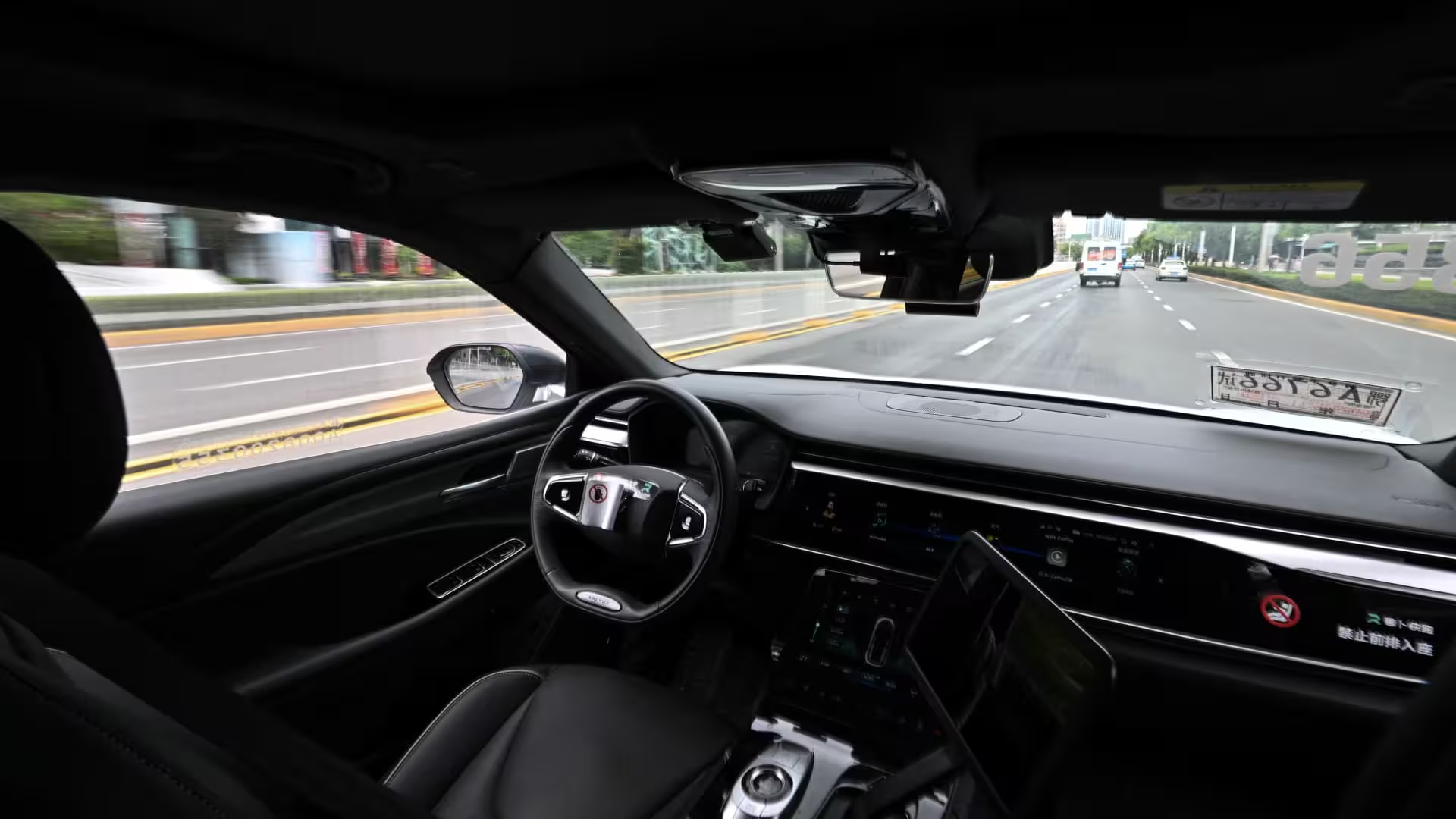

China is at the forefront of autonomous vehicle technology, aggressively pushing the development and deployment of robotaxis across its urban landscapes. With over 16,000 test licenses issued and tens of thousands of kilometers of public test roads opened, the nation's self-driving ambitions are transforming the transportation industry. While this innovation promises increased efficiency and reduced costs, it also sparks significant concerns among traditional taxi drivers about potential job displacement. This article delves into the complexities surrounding China’s robotaxi expansion, analyzing the fears of job loss, the gradual nature of industry transformation, and the new employment opportunities arising within this evolving ecosystem.
The Rise of Robotaxis in China’s Urban Centers
China’s push toward autonomous driving has accelerated rapidly, with tech giants like Baidu leading the charge through initiatives such as the Apollo Go self-driving project. Cities like Wuhan have become focal points where hundreds of robotaxis operate daily, navigating busy streets without human drivers. These vehicles are gradually reshaping urban mobility by offering convenient, cost-effective alternatives to traditional taxis.
The government’s proactive regulatory support, including the issuance of 16,000 test licenses and the approval of nine domestic automakers to test automated driving technologies, underscores the strategic importance placed on autonomous vehicles. This regulatory environment fosters innovation while ensuring safety through controlled public road testing.
Despite the technological advancements, robotaxi adoption remains in its early stages. Baidu’s CEO Robin Li emphasized that robotaxis currently capture only a small fraction of the ride-hailing market, indicating a gradual scaling process that will unfold over several years. This cautious growth allows for technological refinement and public acclimatization.
Concerns Over Job Security Among Traditional Drivers
The expansion of robotaxi services has ignited widespread anxiety among taxi and ride-hailing drivers who fear losing their livelihoods to automation. Social media platforms in China are rife with discussions about autonomous vehicles 'snatching rice bowls,' reflecting deep-rooted concerns about job displacement.
Drivers argue that the affordability and convenience of robotaxis threaten their income streams, especially in cities where robotaxi fares can be significantly lower than traditional ride-hailing services. For instance, a 16-minute robotaxi ride in Beijing’s southern suburbs costs nearly half of what comparable human-driven rides do, intensifying competitive pressures.
This apprehension has prompted some drivers to petition local authorities, such as in Wuhan, where taxi operators requested limits on robotaxi deployment to protect their jobs. Such reactions highlight the social challenges accompanying technological disruption, necessitating balanced policy responses.
Gradual Transition and Industry Adaptation
Experts emphasize that the transition to autonomous mobility will be incremental rather than abrupt, mitigating the immediate impact on driver employment. The shift is expected to vary by region and sector, allowing time for adaptation and workforce reskilling.
Mohit Sharma, a research analyst at Counterpoint Research, notes that while driver displacement is inevitable in the long term, the current shortage of qualified drivers means robotaxis can help fill gaps and improve service quality during the transition period. This perspective frames automation as a complement rather than a complete replacement in the near term.
Governments and companies are encouraged to collaborate on initiatives that support displaced workers, including retraining programs and redeployment strategies. Such measures can facilitate smoother integration of autonomous technologies into the transportation ecosystem while addressing social equity concerns.
Emerging Job Opportunities in the Robotaxi Ecosystem
Contrary to fears of widespread unemployment, the autonomous vehicle sector is generating diverse new job roles that require specialized skills. Baidu’s Apollo Go platform, for example, employs on-road testing operators who monitor autonomous vehicles in real-time and provide critical feedback to improve system performance.
These roles include data annotation specialists who label vast amounts of sensor data to train AI models, as well as remote assistance operators who intervene during complex driving scenarios. Such positions demand technical expertise and offer promising career pathways in a high-growth industry.
The CEO of the Autonomous Vehicle Industry Association, Jeff Farrah, highlights that the industry also creates jobs for service technicians, mapping specialists, dispatchers, and terminal operators. These occupations are essential to maintaining and scaling autonomous services, underscoring that human involvement remains vital despite automation.
Government Initiatives and Policy Responses
China’s regulatory framework actively supports the development of autonomous driving while balancing public safety and social welfare. By issuing extensive test permits and opening public roads for trials, authorities facilitate innovation under controlled conditions.
Simultaneously, policymakers recognize the need to address employment disruptions. Efforts include promoting workforce retraining programs and encouraging partnerships between technology firms and educational institutions to prepare workers for emerging roles in autonomous mobility.
These strategies aim to create a sustainable ecosystem where technological progress does not come at the expense of social stability. By fostering inclusive growth, China seeks to harness the benefits of robotaxis while mitigating adverse effects on vulnerable populations.
Economic and Social Implications of Robotaxi Expansion
The adoption of robotaxis promises significant economic benefits, including reduced transportation costs, improved traffic efficiency, and lowered emissions through optimized driving patterns. These advantages contribute to broader urban sustainability goals and enhance the quality of life in congested cities.
However, the social implications are complex, particularly regarding labor market shifts. The displacement of traditional drivers can exacerbate inequality if alternative employment opportunities are not accessible, highlighting the importance of proactive social policies.
Balancing technological innovation with social responsibility requires multi-stakeholder collaboration involving government, industry, labor organizations, and communities. Transparent dialogue and adaptive policy frameworks will be crucial to navigating these challenges effectively.
Future Outlook: Scaling Robotaxi Services and Workforce Evolution
Looking ahead, robotaxi services are expected to expand steadily, with projections indicating thousands more vehicles operating across Chinese cities in the coming years. This growth will be supported by continuous improvements in AI, sensor technologies, and regulatory harmonization.
As the ecosystem matures, workforce roles will evolve, emphasizing skills in vehicle monitoring, AI system maintenance, cybersecurity, and customer service tailored to autonomous mobility. Education and training programs must align with these emerging needs to prepare the labor force adequately.
Ultimately, the robotaxi revolution represents both a technological leap and a socio-economic transformation. Managing this transition thoughtfully can ensure that China leverages the benefits of autonomous vehicles while fostering inclusive employment opportunities.
Conclusion
China’s ambitious robotaxi push embodies the accelerating wave of automation transforming global transportation. While the prospect of job displacement understandably alarms many drivers, the evolution of autonomous mobility is not a zero-sum game. With thoughtful policy frameworks, industry collaboration, and targeted workforce development, the robotaxi revolution can create new, meaningful employment opportunities. The path forward involves balancing technological innovation with social responsibility to build an inclusive, sustainable future where both humans and machines contribute to smarter, safer urban mobility.
Originally reported by cnbc.com. Adapted for our readers.