
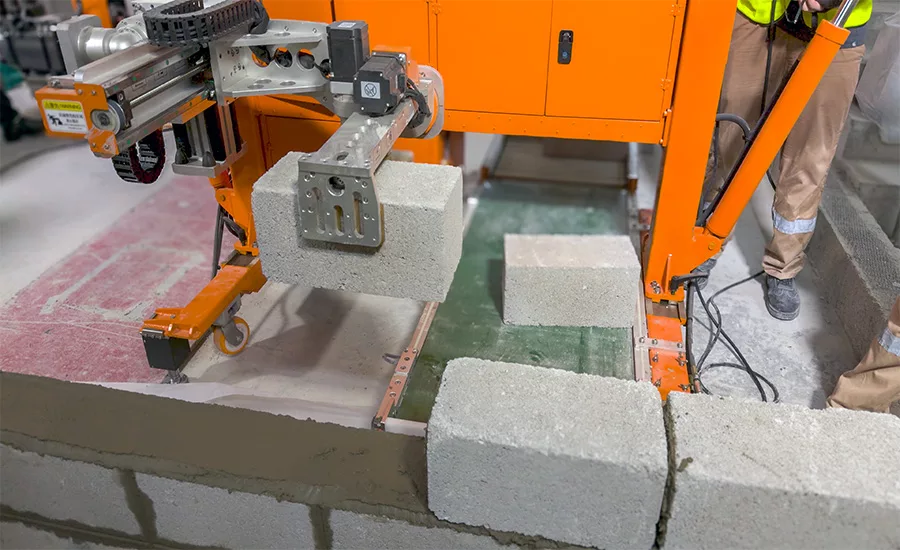

Buildroid AI, a US-based construction robotics startup, is preparing to enter the American market after successful pilot projects in the United Arab Emirates and a $2 million pre-seed funding round led by venture capitalist Tim Draper. Founded by construction-technology veteran Slava Solonitsyn and automation engineer Anton Glance, the company uses Nvidia Omniverse-powered digital twins to simulate robotic bricklaying workflows before any hardware reaches the site. Its first US projects are expected to begin in 2026. The immediate target is blockwork and partition-wall installation, trades that general contractors often cite as bottlenecks. Buildroid's systems can place masonry units weighing up to 40 kg and build walls up to 4 m wide and 3 m tall, coordinated by multiple robots and an autonomous mobile robot for material handling. For independent professionals, this is not simply a robotics story. It is a signal that construction clients need help bridging design models, simulation environments and real-world execution. Freelancers and consultants who can operate in that gap have an opportunity to build a specialised, high-value practice.
The Construction Automation Opportunity
Construction has long struggled with low utilisation rates for automated equipment and fragmented workflows. Buildroid's executives say earlier automation attempts faltered because the economics did not work from day one. By simulating first, the company believes it can identify the workflows that deliver the highest impact before committing capital to hardware.
The start-up's platform is hardware-agnostic and already supports more than 40 robot types. Beyond block-laying, it is working with vendors on digital twins for plastering, concrete levelling, concrete polishing and painting robots. That breadth suggests automation will spread across interior fit-out and, eventually, larger segments of the construction lifecycle.
Independent consultants can position themselves as interpreters between technology vendors and contractors. A general contractor buying its first robotic block-laying system will need help with model preparation, simulation validation, sequence planning and on-site change management. Those are services a solo specialist or small consultancy can deliver.
Where Freelance Opportunities Are Appearing
Buildroid's BIM ingestion workflow is a practical entry point. The company uses an Autodesk Revit plug-in to convert models into OpenUSD, along with a YAML sequencing file and supplementary data. It can operate from LOD300 inputs but typically increases detail to LOD400 or LOD500 within the simulation, adding physical properties, textures and material attributes to reflect field conditions more accurately.
Freelancers who can clean, structure and enrich BIM data are valuable. So are specialists who understand hierarchical task network planning for high-level sequencing and behaviour trees for local task execution. The system performs iterative simulation cycles to validate plans based on cost, time or the number of robots, so consultants who can define and measure those variables have a clear role.
Once a project is live, the persistent digital twin becomes a control centre. If a robot goes offline or site conditions change, the twin updates the plan and redistributes tasks to minimise downtime. Consultants can sell ongoing monitoring, plan updates and performance reporting as a retained service.
Remote Work and Borderless Consulting
Because so much of the work happens in simulation before the robots arrive, location matters less than it once did. A BIM modeller or workflow analyst can serve a contractor in the UAE, the United States or Europe from a home office, provided the data pipeline is secure.
Buildroid's UAE pilots with ALEC, one of the region's largest contractors, confirm that international clients are willing to test robotic workflows virtually before deployment. That creates room for remote specialists to participate in global projects without relocating.
The regulatory context does vary. Solonitsyn noted that the UAE enabled rapid iteration, whereas US rollouts will require more structured pathways because of state-level licensing and compliance requirements. Consultants who understand those local rules can add further value by helping vendors navigate new markets.
Lessons from Buildroid's Simulation-First Model
Solonitsyn's core message is that running thousands of digital-twin simulations before sending a robot to a jobsite lets the company identify high-impact workflows and ensure viable economics from the start. That same discipline benefits consultants.
Rather than selling vague advice, test your recommendations in a model first. Whether you are optimising a project schedule, a pricing structure or a robot fleet, use iteration and measurable outcomes to prove the concept. Clients respond better to evidence than to promises.
Buildroid validates plans against cost, time and robot count. Consultants can mirror that approach by defining the optimisation function upfront: what exactly are you trying to improve, how will you measure it, and what is the threshold for success?
Skills to Build Now
Technical depth in Autodesk Revit and BIM workflows is essential, but it is only the foundation. Learn how models move between formats, particularly OpenUSD and the YAML sequencing files used in robotic planning. Familiarity with Nvidia Omniverse or comparable simulation platforms is increasingly useful.
Domain knowledge matters. Understanding blockwork, partition walls, plastering, concrete finishing and painting helps you speak the contractor's language and spot practical issues that pure software specialists miss.
Study the planning concepts behind the tools: hierarchical task networks for sequencing and behaviour trees for execution. You do not need to be a robotics PhD, but you should understand how tasks are decomposed and assigned. Add project management, data analysis and client communication, and you have a rounded consulting offer.
Pricing, Client Management and Shared-Risk Models
Buildroid is entering the US market under a shared-savings model in which the company receives 50 per cent of net efficiency gains and guarantees performance metrics related to throughput and quality. That is a bold but instructive approach for consultants who want to move beyond hourly billing.
Value-based pricing ties your fee to a measurable outcome the client already cares about. It can take the form of a success fee, a bonus tied to savings, or a phased engagement where the first stage is a low-risk pilot. The key is to define the metric clearly and make sure both sides can verify it.
Be careful not to guarantee results you cannot control. Simulation reduces uncertainty, but it does not eliminate it. Use pilots, clear scope boundaries and realistic performance thresholds to protect your reputation and your cash flow.
What this means
Buildroid AI's planned US rollout is a case study in how construction is becoming more data-driven, simulated and automated. For freelancers and consultants, the practical implication is clear: the people who help contractors plan, model, validate and manage that transition will be in demand. The opportunity is not limited to Silicon Valley or established engineering hubs. With the right skills, a clear offer and a disciplined approach to pilots and performance metrics, independent professionals anywhere can participate. Start by mastering the tools that connect design models to real-world execution, prove your value with small, measurable engagements, and scale as the market matures. The robots may be laying the bricks, but the planning still needs human judgment.
Originally reported by enr.com. Adapted for our readers with AI assistance.


