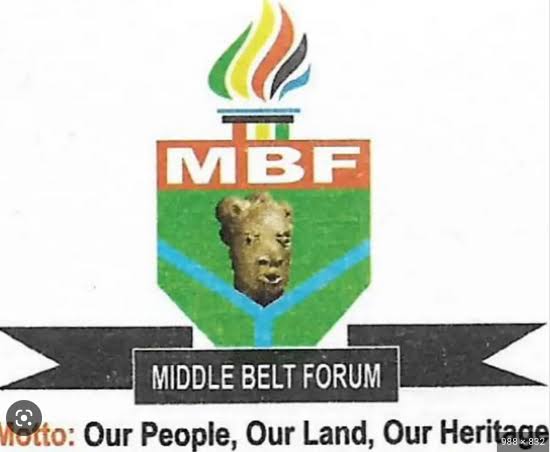

The National Council for Traditional Rulers of Nigeria (Establishment) Bill, 2024, has sparked intense debate following its inclusion of a clause that designates the Sultan of Sokoto as the permanent co-chairman of the proposed council. The Middle Belt Forum (MBF), representing a significant and diverse region within Nigeria, has unequivocally rejected this provision. This article explores the MBF’s objections, contextualizing them within Nigeria’s complex historical and cultural landscape, and examines the broader implications for traditional leadership and national unity.
Background of the National Council for Traditional Rulers Bill
The National Council for Traditional Rulers of Nigeria (Establishment) Bill, 2024, aims to formalize a federal council comprising traditional rulers from across Nigeria. Sponsored by Senator Simon Bako Lalong, a notable Middle Belt politician, the bill seeks to institutionalize the roles and interactions of traditional authorities within the country’s governance framework. Having passed its second reading in March 2025, the bill is currently under scrutiny by the Senate Committee on Establishment and Public Service.
One of the most contentious provisions of the bill is the appointment of the Sultan of Sokoto and the Ooni of Ife as permanent co-chairmen of the council. This arrangement intends to symbolically represent the Muslim and Christian traditional leadership in Nigeria. However, it has triggered debates around historical precedence, regional representation, and religious neutrality within the council.
The proposed council is envisioned as a platform for traditional rulers to advise on cultural, social, and political matters. Yet, the permanent leadership roles assigned to specific monarchs have raised concerns about equity and inclusivity, particularly from the Middle Belt region, which houses numerous distinct ethnic groups and traditional institutions.
MBF's Opposition to the Sultan of Sokoto’s Permanent Role
The Middle Belt Forum has publicly opposed the clause naming the Sultan of Sokoto as a permanent co-chairman, describing it as deeply troubling and unacceptable. MBF National Spokesman Luka Binniyat emphasized that while the forum leaves the Southern region to decide on the Ooni of Ife’s inclusion, it unequivocally rejects the Sultan’s institutionalized leadership role within the council.
MBF’s rejection stems from a belief that the clause undermines the historical and cultural significance of Middle Belt traditional institutions. Binniyat argued that the Sultanate, as an institution, is relatively young compared to ancient kingdoms and confederacies in the Middle Belt, such as the Kwararafa Confederacy, which has centuries of history predating the Caliphate.
The MBF views the permanent co-chairmanship as an imposition that diminishes the stature of Middle Belt rulers such as the Aku Uka of Wukari, the Attah of Igala, the Tor Tiv, and the Etsu Nupe. These rulers represent autonomous peoples with rich histories and traditions, and MBF contends that they should not be expected to defer permanently to the Sultan.
Historical and Cultural Context of the Middle Belt
The Middle Belt region of Nigeria is a mosaic of ethnicities, cultures, and traditional institutions, many of which trace their origins back centuries before colonial rule. The Kwararafa Confederacy, for example, was a powerful and influential entity that flourished long before the establishment of the Sokoto Caliphate in the 19th century.
Traditional rulers in the Middle Belt, such as the Aku Uka of Wukari, are seen as spiritual and political heirs to these ancient confederacies. Their authority is deeply rooted in indigenous customs and historical sovereignty. MBF argues that equating the Sultan’s leadership with these institutions disregards this rich heritage.
Furthermore, the colonial era introduced a hierarchical emirate system that often subordinated Middle Belt communities to Fulani-dominated emirates. MBF views the clause in the bill as a continuation of this colonial legacy, perpetuating an artificial hierarchy that undermines the autonomy and dignity of Middle Belt peoples.
Constitutional and Religious Concerns Raised by MBF
Beyond cultural considerations, the MBF has raised constitutional and religious concerns regarding the Sultan of Sokoto’s role as a permanent co-chairman. As the widely acknowledged spiritual head of Nigerian Muslims, the Sultan’s institutionalized leadership in a secular council could alienate Christians, traditional worshippers, and adherents of other faiths.
Nigeria’s Constitution enshrines secularism and the equal treatment of all religions. MBF warns that the clause could violate this principle by embedding a religious figurehead with permanent authority over a national council meant to represent diverse traditional institutions.
The MBF further argues that the Sultan’s association with religious leadership complicates his suitability for a secular administrative role, potentially compromising the council’s neutrality and inclusivity.
Security and Political Implications
MBF has linked the Sultan of Sokoto to controversial security issues, particularly violence associated with Fulani herders in the Middle Belt. The Sultan’s position as a permanent patron of the Miyetti Allah Cattle Breeders Association (MACBAN) has drawn criticism for perceived insufficient condemnation of violent attacks linked to Fulani militias.
This association raises concerns about the Sultan’s impartiality and ability to promote peace and reconciliation within the council. MBF contends that institutionalizing his leadership could be an affront to victims of such violence and undermine efforts to foster harmony among Nigeria’s diverse communities.
Politically, the clause risks exacerbating regional tensions by appearing to privilege one traditional institution over others, potentially fueling resentment and undermining national unity.
MBF’s Call for Inclusive Leadership Structure
In response to the contentious clause, MBF has proposed alternative leadership arrangements for the council. It advocates for a rotational or democratically elected leadership model to ensure fairness, inclusivity, and equal representation of all traditional rulers irrespective of region or religion.
Such a structure would acknowledge the diversity of Nigeria’s traditional institutions and promote cooperation and mutual respect among rulers. By avoiding permanent appointments tied to specific offices, the council could better reflect the country’s pluralistic nature.
MBF emphasizes that the council must embody the values of equity and unity, serving as a genuine forum for dialogue and collaboration among Nigeria’s traditional authorities.
Potential Consequences if Clause is Retained
The MBF has warned of serious consequences should the Senate pass the bill with the contentious clause intact. It threatens to mobilize ethnic nationalities across the Middle Belt to boycott participation in the council, undermining its legitimacy and effectiveness.
Traditional rulers from the Middle Belt may refuse to recognize or attend council meetings under a leadership structure perceived as biased and exclusionary. This could deepen regional divides and weaken the council’s role as a unifying institution.
The boycott risk also signals broader political ramifications, as it may fuel calls for greater autonomy and challenge efforts at national integration, potentially destabilizing Nigeria’s delicate social fabric.
Broader Implications for Nigerian Traditional Institutions
The dispute over the Sultan’s permanent co-chairmanship reflects wider challenges facing Nigeria’s traditional institutions in balancing historic legacies with contemporary governance needs. It underscores tensions between religious, ethnic, and regional identities within the country’s complex social landscape.
The controversy highlights the importance of designing institutional frameworks that respect the autonomy and dignity of diverse traditional rulers while fostering national cohesion. Failure to address these concerns risks entrenching divisions and marginalizing key stakeholders.
Ultimately, the debate offers an opportunity to rethink how Nigeria’s traditional leadership can evolve in a way that honors history, promotes inclusivity, and supports peace and development.
Conclusion
The Middle Belt Forum’s rejection of the clause naming the Sultan of Sokoto as permanent co-chairman of the National Council for Traditional Rulers underscores deep-rooted historical, cultural, constitutional, and political concerns. The controversy highlights the need for an inclusive approach that respects the autonomy and dignity of all traditional institutions across Nigeria’s diverse regions. Moving forward, adopting a leadership structure that is rotational or democratically elected could foster greater unity and fairness, ensuring the council truly represents the rich tapestry of Nigeria’s traditional authorities while upholding the secular spirit of the nation.