
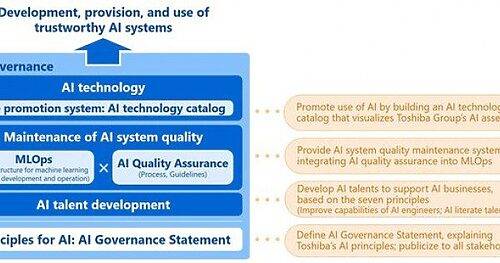

Toshiba Corporation has announced the Toshiba AI Governance Statement, a framework designed to promote the development, provision and use of trustworthy AI across the Group. The statement establishes seven principles aligned with Toshiba's management philosophy and will guide efforts to train human resources capable of researching, developing and using AI, strengthen frameworks for sustaining AI system quality, and promote Group-wide AI governance. The announcement comes as digital transformation makes AI technology more important than ever. Toshiba Group is advancing carbon neutrality and a circular economy through digital transformation, and is applying AI to help address social issues in critical infrastructure and other key areas.
Why AI Governance Matters Now
Artificial intelligence adds convenience and capability, but concerns around its misuse or unintended operation have made ethical guidelines and governance essential. In Japan, the government has formulated several AI-related guidelines, including the Social Principles of Human-Centric AI, AI Utilization Guidelines and Governance Guidelines for Implementation of AI Principles. Overseas legislatures are also taking action, with the European Union's AI Act a prominent example. Addressing AI governance is now a necessity for companies that develop or use AI. In response, Toshiba established the AI Center of Excellence Project Team in April this year to lead Group-wide promotion of the governance required for AI's implementation in society.
The project team formulated the Toshiba AI Governance Statement, in which seven principles clarify the Group's vision of AI technology. That vision is grounded in respect for human dignity, development of AI and related technologies, and an emphasis on fairness. The statement provides Toshiba with foundations for establishing AI governance and implementing initiatives for the development, provision and use of trustworthy AI systems.
Expanding AI Engineering Talent and Literacy
Toshiba has been building AI human resources since 2019, when it launched an AI engineer training program. The program has increased the Group's AI engineer headcount from 750 to 2,100, surpassing this fiscal year's target of 2,000. This growth reflects Toshiba's strategic focus on developing in-house AI expertise to support its digital transformation initiatives across power, social infrastructure and digital devices businesses.
The company has also set up an in-house platform for proactive sharing of information on more than 200 AI assets, 55 of which are showcased at the 'Toshiba AI Technology Catalog.' This internal knowledge-sharing mechanism helps disseminate best practices and lessons learned from various AI projects across the Group, fostering collaboration and avoiding duplication of effort.
The Group is now broadening AI understanding beyond engineers. Alongside the existing engineer program, Toshiba recently introduced training to raise AI literacy among non-engineering managers, improving their ability to provide trustworthy AI to customers. The company also plans to develop training programs for a wider range of employees, not limited to managers or engineers, so that more people across the organization can engage responsibly with AI. This comprehensive approach ensures that AI governance principles are understood and applied consistently throughout Toshiba's global workforce of 120,000 employees.
Building Frameworks to Sustain AI Quality
To maintain the quality of its AI systems, Toshiba is developing AI Quality Assurance Guidelines and quality cards that visualize quality assurance from the customer perspective. The cards detail the performance of AI systems, such as their recognition and accuracy rates, and indicate their strengths and weaknesses based on data characteristics found in learning and evaluation processes. This transparency allows customers to understand an AI system's characteristics and use it correctly, building trust in AI-powered solutions.
Toshiba is also implementing MLOps, infrastructure for machine learning system development and operation, to maintain reliable machine learning models and prevent performance degradation caused by changes in the operating environment. AI systems supported by MLOps are already in use at Toshiba manufacturing sites and in social infrastructure applications, where consistent performance is critical for safety and reliability. The company expects to expand their applications further as part of its commitment to delivering dependable AI technologies.
Connecting Governance to Social Contribution
Toshiba frames its AI governance effort as part of its responsibility to people and the future. The Group is realizing AI governance based on the AI Governance Statement as a way to further contribute to society. Guided by its Basic Commitment, 'Committed to People, Committed to the Future,' and by a business spirit passed down across generations, Toshiba says it is firmly committed to developing, providing and using trustworthy AI systems that help resolve social issues.
This commitment connects directly to Toshiba's broader strategy. The Group is using digital transformation to realize carbon neutrality and a circular economy, and is promoting AI applications that address social issues in critical infrastructure and other important areas. By embedding governance principles into its AI work, Toshiba aims to ensure that technological advancement goes hand in hand with accountability, particularly in sectors where AI decisions can significantly impact public safety and welfare.
What this means
Toshiba's announcement of the AI Governance Statement signals a structured, company-wide approach to responsible AI. By combining clear principles with expanded training, quality assurance frameworks and MLOps infrastructure, the Group is working to ensure its AI systems are not only capable but also trustworthy and well understood by the people who rely on them. The move reflects wider industry pressure to align AI development with ethical standards and emerging regulations, from Japanese government guidelines to the EU AI Act. For Toshiba, the effort also ties back to a long-standing mission: using technology to address social issues and contribute to a sustainable future. Whether measured in trained engineers, deployed systems or governance principles, the company is treating AI accountability as a core business priority that integrates ethical considerations with technological innovation to create sustainable value for society.
Originally reported by festyy.com. Adapted for our readers with AI assistance.


