
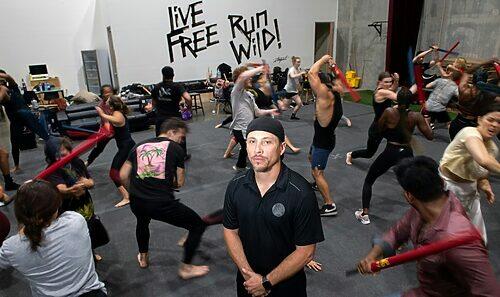

Hollywood's glittering facade masks a growing anxiety among stunt performers as artificial intelligence reshapes the industry. From silent epics to Tom Cruise's death-defying feats, stunt work has long been the heartbeat of action cinema. Now, studios are exploring AI to create digital replicas and generate photo-realistic action sequences without human involvement. While this technological shift threatens traditional roles, many industry experts argue that the authentic human element remains irreplaceable. For freelancers and consultants navigating the gig economy, this evolution offers vital lessons about adapting skills, embracing new tools, and preserving the irreplaceable value of human expertise in an automated world.
The Encroaching Threat of Digital Replication
Studios have long used computer-generated background figures to reduce costs in battle scenes, but AI now enables far more sophisticated applications. Performers are increasingly asked to undergo 3D body scans on set without clear explanations of how their likenesses will be used. These scans could form the basis of detailed digital avatars capable of performing any action or speaking any dialogue, potentially replacing 'nondescript' stunt workers such as pedestrians in car chases.
Stunt coordinator Freddy Bouciegues warns that producers might soon opt to add background figures via effects and AI rather than hiring real performers. This trend reflects a broader industry shift where technological efficiency often trumps human labour, particularly for roles perceived as expendable. For freelancers in any field, this underscores the importance of specialising in skills that are difficult to automate and cultivating a personal brand that clients value beyond mere task completion.
When AI Meets the Limits of Simulation
Director Neill Blomkamp predicts that within six to twelve months, AI could generate photo-realistic footage of high-speed crashes and complex action sequences based solely on directorial instructions. At that point, traditional tools like cameras, stunt performers, and even racetracks might become obsolete for certain types of scenes.
Yet Blomkamp acknowledges current AI still produces 'slightly unpredictable results,' suggesting the technology is not yet ready for seamless integration. This gap between promise and present capability creates a window of opportunity for human performers to demonstrate their irreplaceable value. For consultants and freelancers, this mirrors the reality that while AI excels at pattern recognition and replication, it often struggles with nuanced judgment, improvisation, and the subtle qualities that build trust with clients.
The Irreplaceable Human Element in Action Cinema
Despite AI's rapid advancement, Bouciegues maintains that audiences can still detect when computer-generated imagery replaces human performance. He points to Tom Cruise's recent films, where real stunt work creates a subconscious impact that resonates with viewers. This authenticity stems from the genuine risk, skill, and physical commitment that only human performers can bring to dangerous sequences.
This principle extends far beyond Hollywood. In consulting, freelancing, and skilled trades, clients often pay premiums for the confidence that comes from proven human expertise. Whether it's a craftsman's touch, a consultant's intuitive problem-solving, or a performer's split-second timing, the human element frequently delivers value that pure automation cannot replicate or that clients perceive as inferior.
A Blended Future: Humans and Technology Working Together
Bouciegues envisions the most promising outcome as a hybrid approach where human stunt performers collaborate with VFX and AI to achieve sequences too dangerous for traditional methods alone. This model preserves the irreplaceable human core while leveraging technology to enhance safety and creative possibilities.
For freelancers and consultants, this offers a powerful framework for career longevity. Rather than resisting technological change, successful professionals learn to integrate new tools into their workflow—using AI for research, data analysis, or routine tasks while focusing their energy on the high-value, human-centric aspects of their work that clients truly appreciate.
Navigating Uncertainty in the Gig Economy
The ongoing SAG-AFTRA and writers' strike highlights a critical concern: the lack of guarantees about how AI-generated likenesses will be used in the future. Studios propose rules around informed consent and compensation, but performers fear being paid for one day's work only to have their digital replicas used 'for the rest of eternity.'
This anxiety resonates with freelancers worldwide who worry about platforms using their work to train AI systems that could eventually replace them. The lesson is clear: professionals must advocate for transparent policies, negotiate terms that protect their ongoing rights, and continuously develop skills that keep them ahead of automation curves. Building a diverse client base and maintaining direct relationships reduces dependence on any single platform or technology shift.
What this means
The rise of AI in Hollywood stunt work serves as a powerful metaphor for challenges facing freelancers and consultants across industries. While technological advancement threatens to automate certain tasks, the enduring value of human skill, judgment, and authenticity remains a cornerstone of professional excellence. The most successful independent professionals will not be those who resist change, but those who harness new tools to amplify their uniquely human strengths—much like stunt performers who combine their physical expertise with safety-enhancing technology to create more spectacular and responsible action sequences. In an age of algorithms and avatars, the human touch continues to be the ultimate differentiator.
Originally reported by festyy.com. Adapted for our readers with AI assistance.


