
Executive Summary
Nigeria’s press freedom landscape in 2024 remained precarious, marked by persistent pressure on journalists, legal constraints, and violent intimidation, even as the country recorded a modest improvement in its global press-freedom ranking. Across 22 of the nation’s 36 states, authorities displayed tendencies that restrict media freedom, while security forces were responsible for the majority of documented attacks on journalists during the #EndBadGovernance protests and other incidents (Various Authors, 2026, [12]; Various Authors, 2026, [7]). High-profile cases such as the February 2024 abduction and torture of Segun Olatunji, editor of First News, illustrated the extreme risks faced by media practitioners (Various Authors, 2026, [9]). Legal frameworks that criminalise defamation, empower anti-terrorism statutes, and enforce restrictive broadcast regulations continue to enable obstruction of journalistic work, despite constitutional guarantees of free expression (Various Authors, 2026, [10]; Various Authors, 2026, [13]).
The media environment is simultaneously vibrant and fragile: over 80 locally owned digital outlets enrich the landscape, yet declining advertising revenue and the proliferation of misinformation undermine sustainability and credibility (Various Authors, 2026, [8]; Various Authors, 2026, [20]). Politically, President Bola Tinubu’s reelection bid amid rising insecurity and power-sector crises has intensified the struggle over narrative control, with political leaders invoking nationalist rhetoric to deflect criticism (Various Authors, 2026, [16]; Various Authors, 2026, [11]). Although Nigeria’s World Press Freedom Index ranking improved from 122nd in 2025 to 112th in 2026, the nation still ranks 112th out of 180 countries, indicating that journalists remain subject to monitoring, attack, and arbitrary arrest (Various Authors, 2026, [14]; Various Authors, 2026, [15]; Various Authors, 2026, [17]). The battle for truth in Nigeria therefore unfolds at the intersection of state power, legal repression, economic pressure, and a fragmented information ecosystem—challenges that demand sustained institutional reform, journalist safety mechanisms, and a concerted effort to counter disinformation while safeguarding editorial independence.—
Analysis
1. The Landscape of Press Freedom in 2024
Nigeria’s press freedom climate in 2024 was characterised by contradictory signals. On one hand, the 2024 Openness Index compiled by the Centre for Journalism Innovation and Development revealed that 22 of the country’s 36 states exhibited tendencies that restrict press freedom (Various Authors, 2026, [12]). On the other hand, Nigeria’s global press-freedom ranking improved modestly, climbing from 122nd in 2025 to 112th in 2026 (Various Authors, 2026, [17]). This apparent progress must be contextualised: the country still ranked 112th out of 180 nations, meaning journalists continue to face regular monitoring, attacks, and arbitrary arrests (Various Authors, 2026, [14]; Various Authors, 2026, [15]).
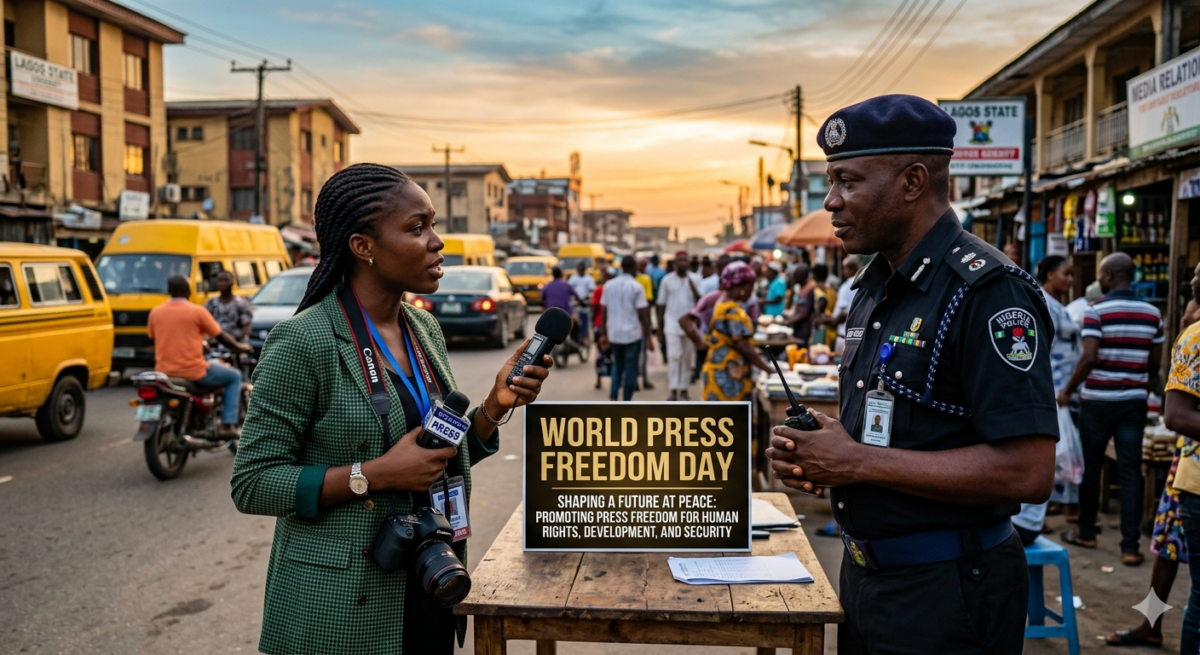
The nature of these pressures is multifaceted. In conflict-affected regions, reporting is especially perilous; 2024 saw journalism described as “deadly” in zones of insurgency and communal violence (Various Authors, 2026, [5]). During the nationwide #EndBadGovernance protests, the Committee to Protect Journalists documented 56 incidents of journalists being assaulted or detained by security agencies (Various Authors, 2026, [7]). A stark illustration of state-linked violence emerged in February 2024 when Segun Olatunji, editor of First News, was abducted by 15 armed men who seized his family, threatened them, and forced them to reveal his location. While detained, Olatunji was stripped, blindfolded, and shackled for three days (Various Authors, 2026, [9]). Such episodes underscore that the security apparatus, tasked with protecting citizens, often becomes a vector of intimidation against the press.
2. Legal and Structural ConstraintsNigeria’s constitution guarantees freedom of expression, yet a tangled web of statutes undermines that guarantee. The penal code continues to treat defamation as a criminal offence, while anti-terrorism and state-secrets laws provide broad discretion to security agencies to curb reporting deemed “sensitive” (Various Authors, 2026, [10]). The Cybercrimes Act, amended in 2024, remains a point of contention: although reforms were introduced, stakeholders warn that its provisions can still be applied in ways that impede press freedom (Various Authors, 2026, [13]). Broadcast regulations administered by the National Broadcasting Commission further restrict content, particularly when it pertains to governance, security, or corruption.
These legal tools are not merely theoretical; they are routinely invoked. In 2024, numerous journalists faced charges ranging from cyber-stalking to terrorism-related offenses for publishing investigative reports on government contracts or security operations (Various Authors, 2026, [5]). The chilling effect of such prosecutions encourages self-censorship, eroding the watchdog function of the media.
3. Economic Pressures and the Rise of Digital Media
Despite legislative and physical threats, Nigeria’s media sector has experienced a surge in digital entrepreneurship. Over 80 locally owned digital news outlets or startups now operate across the country, reflecting a vibrant appetite for alternative news sources (Various Authors, 2026, [8]). However, this growth is undermined by deteriorating advertising revenues, as traditional advertisers shift spend to international platforms or withdraw amid economic uncertainty (Various Authors, 2026, [8]). The resulting financial fragility makes outlets vulnerable to patronage or coercion from political actors seeking favourable coverage.Compounding these economic strains is the pervasive problem of misinformation and disinformation. A recent scholarly analysis of the Nigerian media landscape highlighted how false narratives proliferate on social media, often amplified by partisan actors, thereby eroding public trust in legitimate journalism (Various Authors, 2026, [20]). In an environment where falsehoods spread rapidly, journalists face the dual burden of verifying truth under duress while competing with sensationalist content that can garner greater attention—and revenue.
4. Political Context and the Battle for Narrative
The struggle over truth in Nigeria cannot be divorced from its political dynamics. President Bola Tinubu’s bid for a second term unfolded against a backdrop of rising terror attacks, chronic power shortages, and public frustration over governance (Various Authors, 2026, [16]). In this climate, political leaders have increasingly resorted to nationalist rhetoric and outright threats to shape public discourse. For instance, former U.S. President Donald Trump’s Truth Social post threatening military intervention in Nigeria was framed by Nigerian officials as an external affront that justified heightened security measures—measures that, in practice, often curtailed press freedoms (Various Authors, 2026, [11]).
Such narratives serve a dual purpose: they rally domestic support around a perceived external threat while delegitimising critical reporting as “unpatriotic” or “foreign-influenced.” The government’s emphasis on securing electricity supply and promising not to charge estimated bills—illustrated by Tinubu’s campaign pledge—demonstrates how performance-based promises are used to deflect scrutiny (Various Authors, 2026, [16]). When journalists investigate discrepancies between promises and outcomes, they risk being labelled as agents of destabilisation.
5. International Benchmarks and Domestic Perception
International watchdogs continue to flag Nigeria as a country where press freedom is under serious threat. The 2024 World Press Freedom Index, compiled by Reporters Without Borders, placed Nigeria at 112th, noting that elections are frequently accompanied by violence against journalists (Various Authors, 2026, [3]; Various Authors, 2026, [4]). Domestic perceptions mirror these assessments: a Facebook-based survey noted that, despite the modest ranking improvement, many Nigerians still perceive the press as hampered by intimidation and legal harassment (Various Authors, 2026, [15]; Various Authors, 2026, [17]).
The modest upward movement in the global ranking—rising ten places from 122 to 112—has been greeted with cautious optimism by press-freedom advocates, who attribute it partly to advocacy efforts and increased international scrutiny (Various Authors, 2026, [17]). Yet the same sources caution that the improvement is fragile and contingent on sustained reforms, particularly the repeal or amendment of laws that criminalise journalistic activity.
6. Pathways Forward
Addressing Nigeria’s battle for truth requires a multi-pronged strategy. Legislative reform is paramount: revising the penal code to decriminalise defamation, narrowing the scope of anti-terrorism statutes as they apply to journalism, and ensuring that the Cybercrimes Act targets genuine cyber-offences rather than legitimate reporting. Strengthening the independence of regulatory bodies such as the National Broadcasting Commission would also reduce arbitrary content restrictions.
Simultaneously, enhancing journalist safety demands concrete mechanisms—rapid-response units within police forces, witness-protection programmes for reporters, and unequivocal condemnation of attacks by senior officials. The international community can support these efforts through capacity-building programmes, legal-defence funds, and diplomatic pressure when violations occur.
Economically, fostering a sustainable advertising ecosystem—perhaps through incentives for local advertisers and transparent media-rating systems—would lessen outlets’ dependence on partisan patronage. Finally, combating misinformation necessitates a collaborative approach: media houses investing in fact-checking units, platforms improving algorithmic transparency, and media-literacy campaigns empowering the public to discern credible information.
—### Conclusions
Nigeria’s press freedom environment in 2024 illustrates a tense paradox: modest gains in global rankings coexist with pervasive legal, physical, and economic pressures that threaten the very essence of journalistic independence. The country’s constitutional guarantees remain undermined by statutes that enable state interference, while journalists operate under the constant threat of abduction, assault, and legal harassment—exemplified by the abduction of Segun Olatunji and the dozens of attacks recorded during the #EndBadGovernance protests.
Economic headwinds, particularly dwindling advertising revenues, and the surge of misinformation further erode the media’s capacity to serve as a reliable watchdog. Political leaders, seeking to consolidate power amid insecurity and service-delivery failures, often resort to nationalist rhetoric that delegitimises critical reporting, thereby tightening the grip on the flow of information.
Nevertheless, the vibrant growth of digital news outlets and the modest improvement in the World Press Freedom Index signal that avenues for progress exist. Realising a freer press will require deliberate legislative reform, robust safety protocols for journalists, economic sustainability measures, and a concerted fight against disinformation. Only through such comprehensive efforts can Nigeria hope to translate its constitutional commitment to free expression into a lived reality where truth can prevail over power.
—### References
Various Authors. (2026). Evaluating the level of Press Freedom in Modern Nigeria. https://www.academia.edu/118920639/Evaluating_the_level_of_Press_Freedom_in_Modern_Nigeria
Various Authors. (2026). A Compendium of Press Freedom Violations in Nigeria …. https://thecjid.org/document/escalating-threats-on-journalism-a-compendium-of-press-freedom-violations-in-nigeria-from-may-2023-to-december-2024
Various Authors. (2026). 2024 World Press Freedom Index – journalism under political pressure | RSF. https://rsf.org/en/2024-world-press-freedom-index-journalism-under-political-pressure
Various Authors. (2026). 2024 World Press Freedom Index – journalism under political pressure [EN/RU] – World | ReliefWeb. https://reliefweb.int/report/world/2024-world-press-freedom-index-journalism-under-political-pressure-enru
Various Authors. (2026). Journalism in Nigeria: A 2024 Review. https://www.youtube.com/watch?v=jtw5fIkEs7oVarious Authors. (2026). Who is attacking journalists in Nigeria? Between Dec 2024 …. https://www.instagram.com/reel/DQ38UMQgDQH
Reuters. (2026). Nigeria | Reuters Institute for the Study of Journalism. https://reutersinstitute.politics.ox.ac.uk/digital-news-report/2025/nigeria
Reuters. (2026). Nigeria | Reuters Institute for the Study of Journalism. https://reutersinstitute.politics.ox.ac.uk/digital-news-report/2024/nigeria
Various Authors. (2026). Nigeria: Freedom on the Net 2024 Country Report | Freedom House. https://freedomhouse.org/country/nigeria/freedom-net/2024
Various Authors. (2026). Nigeria | RSF. https://rsf.org/en/country/nigeria
Various Authors. (2026). With Trump’s threats of military intervention in Nigeria, Tinubu faces a delicate balancing act – Atlantic Council. https://www.atlanticcouncil.org/blogs/new-atlanticist/with-trumps-threats-of-military-intervention-in-nigeria-tinubu-faces-a-delicate-balancing-act
Various Authors. (2026). ANALYSIS: Press Freedom, Power and Nigeria’s Battle for Truth – PRNigeria News. https://prnigeria.com/2026/05/06/press-freedom-power-truth
Various Authors. (2026). Four Charts Revealing Nigeria’s Decline in Press Freedom | Dataphyte Insight. https://www.dataphyte.com/topic/security/four-charts-revealing-nigerias-decline-in-press-freedomVarious Authors. (2026). Press Freedom in Nigeria: Ranking, risk and the risk ahead. https://www.youtube.com/watch?v=1qv8WA7WncE
Various Authors. (2026). Nigeria ranks 112 out of 180 on the 2024 Press Freedom …. https://www.facebook.com/guardianng/posts/nigeria-ranks-112-out-of-180-on-the-2024-press-freedom-index-what-does-this-say-/1252057689614992
Various Authors. (2026). Tinubu Facing Headwinds for Reelection Amid Rising Terror, Power Crisis – Truth Nigeria. https://truthnigeria.com/2026/05/tinubu-facing-headwinds-for-reelection-amid-rising-terror-power-crisisVarious Authors. (2026). Nigeria’s press freedom ranking improves despite challenges. https://www.facebook.com/groups/1914482442034609/posts/3507737539375750
Various Authors. (2026). Events That Shaped Year 2024 In Nigeria | Rubbin’ Minds. https://www.youtube.com/watch?v=dGtCWWto-WsVarious Authors. (2026). This year alone, 15 press attacks have been documented …. https://www.facebook.com/Premiumtimes/posts/this-year-alone-15-press-attacks-have-been-documented-in-nigeria-the-country-ran/1458405262986460
Various Authors. (2026). [PDF] Misinformation and disinformation in the Nigerian media landscape. https://www.ssoar.info/ssoar/bitstream/document/95810/1/ssoar-imsujcomms-2024-1-onigbinde_et-al-Misinformation_and_disinformation_in_the.pdf
Originally reported by prnigeria.com. Adapted for our readers.