
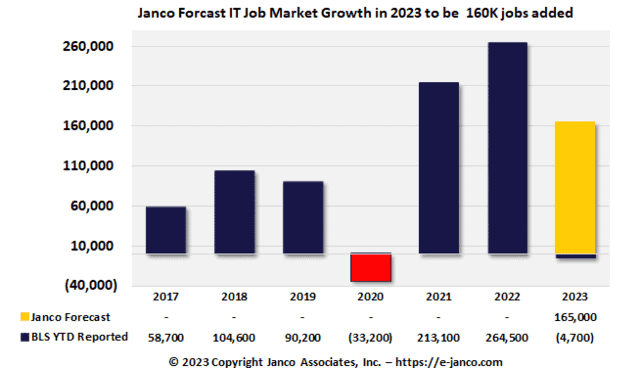

(Park City UT Janco Associates Inc. (https://e-janco.com)Janco reports that 2022 saw an increase of 264.5K new jobs added to the IT job Market. Those new jobs were in addition to the 213,000 jobs created in 2021. This increased demand raised overall salaries for all IT positions by 5.6%, with SMBs seeing an average increase of 7.74% with their median compensation increasing to $100,434 as reported in Janco 2023 IT Salary Survey (see https://e-janco.com/salary.htm ).
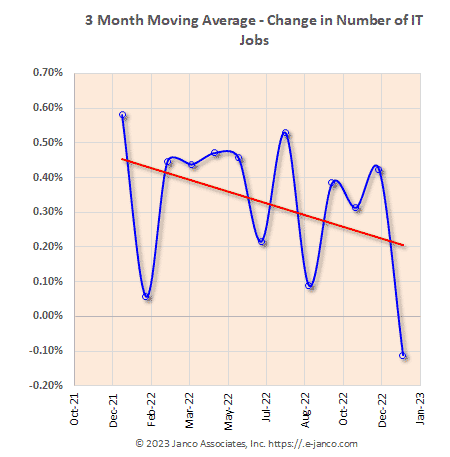
In January the growth of the IT job market stopped with a decline of 4,700 jobs. That was the first loss in over 27 months. The three-month moving average of IT job market growth went negative with a trend line that shows a further decay in IT job market growth. At the same time, there is an excess of 109K unfilled jobs for IT Pros due to a lack of qualified candidates.
Janco releases “CIO and HR Staff Management Kit” to help CIOs and HR to better navigate the changing landscape of today’s business climate.
The CEO of Janco, M. Victor Janulaitis said, “Based on our analysis, the IT job market and opportunities for IT professionals are there but not in as broad in scope as in 2022. Layoffs, for the most part, did not hit developers. Rather they were focused on data center operations, administrative and HR roles related to recruiting, and DEI (diversity, equity, and inclusion). Some roles, especially in telecommunications and data center operations are being automated and eliminated. Driving this is, CIOs and CFOs who are looking to improve the productivity of IT by automating processes and reporting where possible. They are focusing on eliminating “non-essential” managers and staff. They will continue to hire coders and developers. The highest demand continues to be for security professionals, programmers, and blockchain processing IT Pros. Currently, there are over 109K unfilled jobs in the IT job market a drop from 216K in November.”
He said, “The possibility of the economic downturn is very likely and is impacting all decisions that increase technology-related expenditures. Work from home is being minimized as companies are requiring employees to be in the office at least 3 to 4 days a week. Mid-level managers are now having to justify most positions where the IT Pro is not working in the office. Companies that are forced to hire replacements, do so with the caveat that payroll costs remain flat. The 2023 IT budgets increased salaries for IT pros to address inflationary pressures faced by employees. Those are now being reviewed. Given these facts, we believe that median salaries for IT Pros in 2023 will be 3-4% salary above 2022 levels, not the 7%-8% that was budgeted.”
The CEO added, “According to the latest BLS data analyzed, there are now just over 4.2 million jobs for IT Professionals in the US. Layoffs at big tech companies are having an adverse on overall IT hiring. More CIOs are looking at a troubling economic climate and are evaluating the need for increased headcounts based on the technological requirements of their specific business operations.”
The CEO added, “Morale is a mixed bag in many IT groups. Salary compression has occurred from the earlier hiring efforts with new employees being paid more than existing employees. That has impacted existing employee morale. Another factor for employee morale is the move by companies in all industries and sizes to improve productivity by laying off excess staff.” Also, “Companies are looking to increase the span of control (number of people who report to each manager and supervisor) of those in middle and upper management who remain and are focusing on reducing the number of layers of management between the top IT executive and the lowest level of workers.”
Janulaitis said, “Many of the issues faced by the economy are due to supply chain problems. If China opens, overall supply chains should improve but will take several months. That should lessen the recessionary pressures that are driving companies to reduce staff.”
Janco is an international consulting firm that follows issues that concern CIOs and CFOs. The firm publishes a series of IT and business Infrastructure HandiGuides® and Templates including IT Infrastructure Policies and Procedures, Disaster Recovery/Business Continuity Template, Security Template, IT Job Descriptions, and its semi-annual IT Salary Survey.
With this as a background, Janco has just revised downward its forecast for the growth of the IT Job Market in 2023 to just over 160K from 174K new jobs. That will be less growth than in 2021 and 2022, but still at high levels. To assist in the recruiting process and address this growth, Janco has just released the 2023 editions of two products, 1) the 2023 edition of 324 full IT Job Descriptions (see https://e-janco.com/it-job-descriptions.htm) and 2) the 2023 edition of the IT Hiring Kit (see https://e-janco.com/ithirepack.htm).